
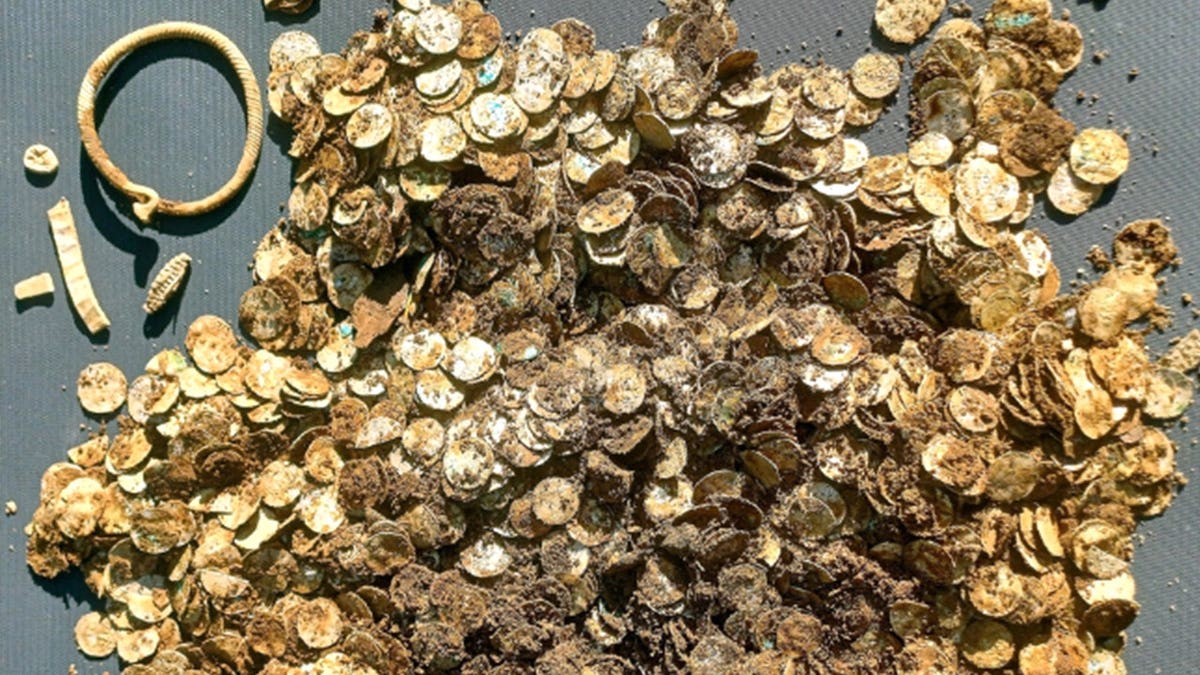
A significant archaeological find has emerged in Finland, where a metal detectorist unearthed a vast Viking Age silver hoard, reportedly the largest ever discovered in the nation.
The treasure consists of more than 4,000 coins and was found near the village center of Sysmä, a town around 105 miles northeast of Helsinki. Metal detectorist Kalle Lappinen discovered the hoard on September 3 and promptly informed authorities. The following day, archaeologists from Lahti Museums began recovering the artifacts.
A massive Viking Age silver hoard discovered near Sysmä, Finland, is estimated to contain more than 4,000 coins.
According to museum reports, the hoard comprises thousands of silver coins, hack silver, a silver bracelet, a mount, and a bead. The coins hail from regions now known as Sweden, Britain, Germany, Turkey, and Iran.
The total weight of the coins is approximately 10 pounds, and they are believed to date back to between 1000 and 1050 A.D. Esko Tikkala, an archaeologist with Lahti Museums, explained that this dating is preliminary and subject to change after thorough cleaning and analysis.
Tikkala has excavated other hoards from the Late Iron Age but expressed astonishment at Sysmä’s find due to its size. He noted that while previous finds typically contain tens or hundreds of coins, this discovery features thousands.
Researchers are studying thousands of coins from the Sysmä hoard to learn more about their origins and the silver economy of the period.
Current research seeks to understand the hoard’s origins and the silver economy during the era, indicating that Sysmä was a hub with extensive trade connections during the Late Iron Age. Despite the region’s modest present status, the archaeological findings suggest a vibrant past.
This hoard contains more than twice the number of coins found in Finland’s previously largest known Viking Age hoard, which was discovered in Nousiainen in 1895.
The identity of the hoard’s original owner remains a mystery. However, Tikkala speculates that a merchant or a local inhabitant might have buried the items for safekeeping, possibly due to threats or conflict; yet the exact reason remains unknown.
Frida Ehrnsten, responsible for numismatic collections at the National Museum of Finland, stated that the discovery could revolutionize understanding of how silver circulated in the region around 1,000 years ago. While people in Finland during that time are not typically labeled as Vikings, the term ‘Viking Age’ describes the broader era and cultural context.
It’s kind of a double hoard. We haven’t really had any known examples of those from before.
Ehrnsten highlighted the fascinating nature of the find, noting that it constitutes two separate deposits found roughly 39 feet apart.
The involvement of hobby metal detectorists has greatly contributed to increased archaeological discoveries across Finland. Approximately 25 years ago, there were around 7,000 Viking Age coins known in Finland. Today, the number has doubled, standing at approximately 14,000. Metal detecting enthusiasts have played an integral role in uncovering such treasures.