
On Tuesday, severe storms in Northwest Indiana left most of the region without power. Residents and public workers faced numerous challenges as they began recovering from the widespread damage caused by downed trees and power lines. Many communities declared disasters and urged people to stay off the roads for cleanup and power restoration efforts.
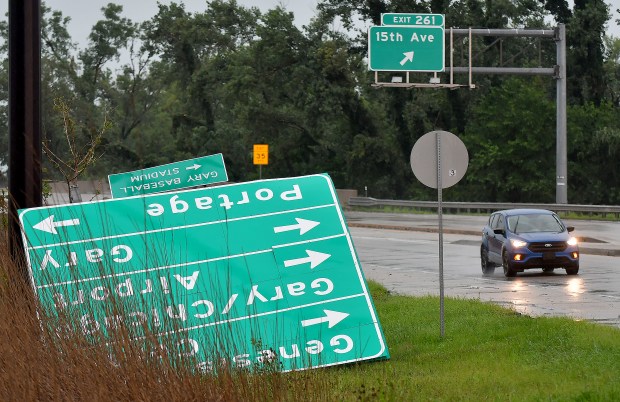
A downed highway sign was seen along U.S. 12 in Gary, Indiana, on Wednesday, August 12, 2026, following the storms. The impacted areas as of 11 a.m. Wednesday included Cedar Lake, Chesterton, Crown Point, Dyer, East Chicago, Gary, Griffith, Hammond, Highland, Hobart, LaPorte, Lake Station, Lowell, Merrillville, Michigan City, Munster, Portage, Saint John, Schererville, and Valparaiso. Residents were asked to conserve water and sewer usage since these systems were working off power backups. Power restoration might take days as NIPSCO faced its largest outage, leaving about 287,000 customers without electricity. Kankakee Valley REMC reported 10.5% of its customers remained without power by 2:30 p.m. Wednesday.
A strand of trees fell at Old Settlers Cemetery on Indiana 51 during the storm on Tuesday, Aug. 11, 2026, in Hobart.
The National Weather Service recorded gusts up to 99 mph at the Gary/Chicago International Airport on Tuesday. Meteorologist Gino Izzi noted that Lake, Porter, and Newton counties were hardest hit, with about 95% of Lake County losing power. Izzi confirmed tornado tracks from Illinois continued into western Lake County and described the storm as a derecho, with embedded tornadoes.
Portage Mayor Austin Bonta declared a state of emergency and requested the state to do the same to access necessary resources. The storm resulted in a fatality, multiple gas leaks, and shortages of food and essential supplies in Portage. Bonta reminded citizens about safe generator use to prevent fume-related accidents, citing a past fatality at Lakeshore Camp Resort in June due to improper generator proximity. Community efforts such as food distribution by the Salvation Army were underway, and local organizations like the American Legion Post 260 provided meals for residents.
Throughout the affected areas, examples of community support emerged. Valparaiso Mayor Jon Costas highlighted ongoing cleanup efforts, hindered by downed power lines, while loaning city resources to assist neighboring towns. Residential areas experienced significant damages. For instance, in Gary, residents like Ramon Jones and Dwayne Tillman faced severe property damage and power outages, emphasizing the storm’s impact. Munster residents, including Ron Alaguer, worked on clearing debris and utilized generators, anticipating lengthy power restoration.
The Lake County Fair adjusted plans due to power issues. The fairgrounds faced closures, with 4-H shows limited to participants, and event cancellations prompting refunds. The Gary/Chicago International Airport ceased operations temporarily for cleanup, with minimal hangar damage reported.
Efforts to clear debris were ongoing; parks and golf courses like Wicker Memorial Park remained closed. Griffith continued dealing with damages from June’s storm. Crown Point faced similar closures and declared its second disaster since June. Amidst widespread damage, public and emergency services remained operational, assisting in recovery efforts.
Schools postponed the start of classes. Andrean High School, among others, delayed its opening due to widespread power outages and damage. Many school buildings sustained damage, with decisions regarding reopening to be made based on conditions.
Local businesses and community centers offered support. For example, Ricky Hanft from The Wurst in Griffith hosted a community cookout using resources from his butcher shop, while other establishments provided free meals and charging centers for residents.