
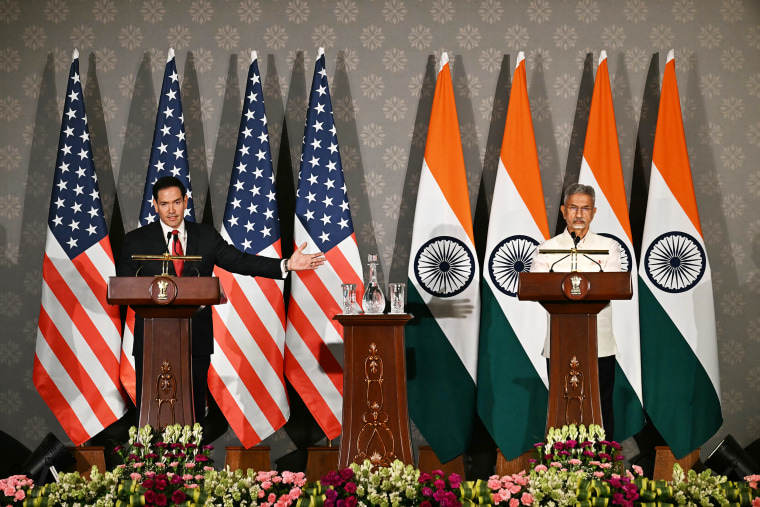
Marco Rubio’s Arrival in New Delhi
Summers in New Delhi are notoriously harsh, challenging even those familiar with intense heat, like Floridians. Secretary of State Marco Rubio encountered this upon his arrival in India, facing temperatures exceeding 100 degrees during his four-day visit. His schedule included meetings with Indian Prime Minister Narendra Modi and foreign ministers from India, Australia, and Japan. He also toured the Taj Mahal, attracting comments on social media about the oppressive heat.
‘I wanted to keep this brief because it’s hot. It’s hot,’ Rubio remarked on Saturday, during the inauguration of the new U.S. Embassy building. Despite the absence of Miami’s notorious humidity, Rubio noted the intense heat expected to cool down as the day progressed.
Strategic Discussions and Quad Developments
Rubio’s visit came at a crucial time for the Indo-Pacific alliance known as the Quadrilateral Security Dialogue or Quad, impacting U.S.-India relations. Recent tensions arose due to steep tariffs on Indian exports by the previous administration. While interim agreements have been reached, disputes linger, particularly concerning energy. U.S. interactions with Pakistan over the war involving Iran worried India, given the ongoing terrorism concerns tied to Pakistan.
Tuesday’s discussion with Quad counterparts resulted in several initiatives in the Indo-Pacific. These included developments in maritime surveillance, port infrastructure, and critical minerals, underscoring the importance of maritime security for global trade.
‘Beyond the fact that current events remind us of what can happen when maritime security is impeded, is the fact that 60% of global maritime trade passes through the Indo-Pacific,’ Rubio stressed, citing national interests associated with this vital trade region.
Challenges from China
The discussion did not escape attention from China. The Chinese Foreign Ministry spokesperson Mao Ning remarked that cooperation should not target third parties or foster bloc confrontation. She emphasized mutual trust and collaboration among countries.
Rubio and his wife, Jeanette, faced high temperatures elsewhere in India, particularly at Jaipur’s Amber Fort and Mother Teresa’s resting place in Kolkata. The heat elicited sarcastic social media reactions, with commentary on the timing of Rubio’s visit.
The challenges extend beyond temperature, as India grapples with fuel price hikes linked to the effective shutdown of the Strait of Hormuz by Iran. Rubio’s dialogue included seeking resolutions to reopen the strait, hinting at prospective deals between Washington and Tehran.
Positive Outlook on U.S.-India Relations
Despite the sweltering conditions, Rubio expressed optimism about the U.S.-India relationship. During a Sunday event in New Delhi, he emphasized the importance and potential of bilateral cooperation. Celebrating the upcoming 250th anniversary of U.S. independence, he highlighted shared interests and the strategic necessity to safeguard critical minerals and rare earth supplies, referencing challenges posed by China.
The Quad countries, the U.S., India, Japan, and Australia, jointly rebuked destabilizing and unilateral actions in their statement, pointing toward peace in the region. They cited interference and militarization concerns, referencing disputes in the South China Sea.
Continuation of Diplomatic Efforts
Following his visit to India, Rubio proceeded to Yerevan, Armenia, for a diplomatic meeting involving a Memorandum of Understanding Signing Ceremony. This reflects Armenia’s ongoing efforts to diversify energy ties beyond Russian influence.