
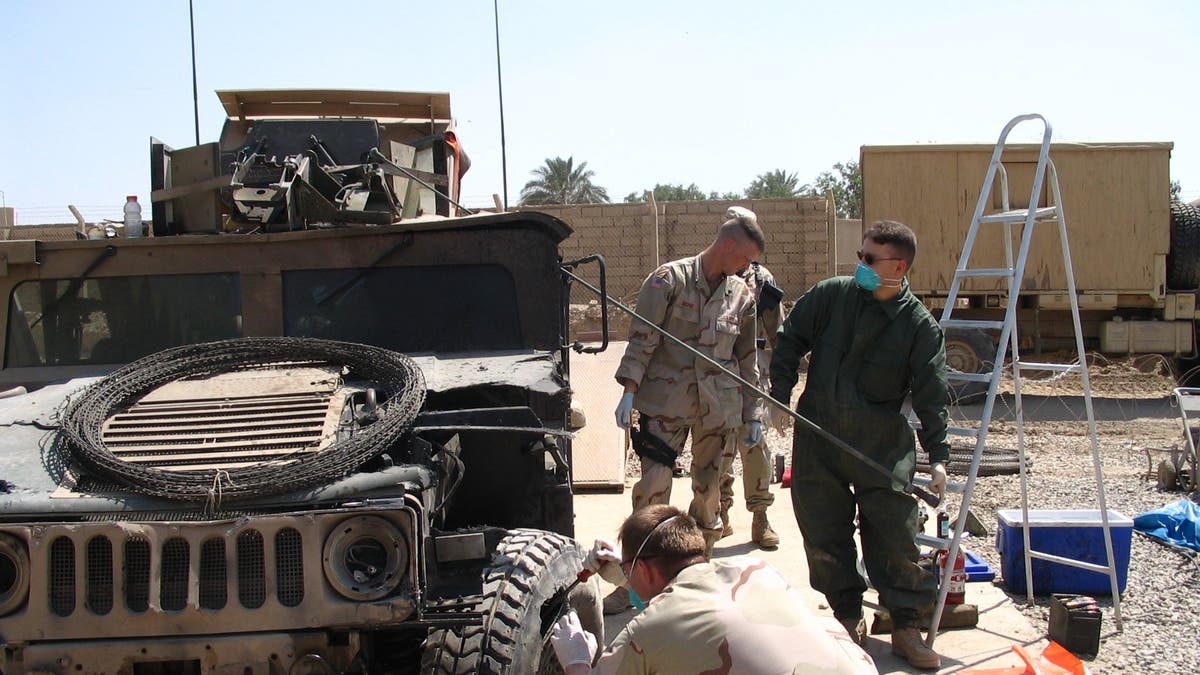
Two decades before the recent conflict with Iran escalated, an explosively formed penetrator hit a U.S. Army vehicle on a Baghdad road. The attack took the life of Staff Sgt. William Brooks and left Sgt. (Ret.) Robert Bartlett with severe injuries. Bartlett recalls being fatally wounded multiple times.
The weapon was linked to an Iranian campaign arming proxy forces to target American troops. According to federal court findings, these attacks were carried out using Iranian-manufactured or supplied weapons, and the assailants received training or directives from the Islamic Revolutionary Guard Corps.
“It cut me in half from my temple down through my jaw,” Bartlett said, detailing the attack. He received extensive medical treatment over four years at Walter Reed.
Bartlett was driving an armored Humvee in Baghdad on May 3, 2005, during a route-security mission when the explosive detonated. This attack resulted in significant injuries to Bartlett and the loss of Sgt. William Brooks.
Army reports describe Bartlett’s condition as “very seriously injured” with severe facial and dental trauma. The weapon was identified as an Iranian-supplied penetrator connected to the Iranian mission against American soldiers in Iraq.
Capt. Shawn English and Maj. Stuart Wolfer’s deaths also linked to Iran’s actions show a consistent strategy. English died from a similar explosive device, while Wolfer was killed by a rocket attack within a U.S. base.
“He really was my best friend,” said Beverly Wolfer Nerenberg about her brother. Wolfer died in 2008 when the roof of the gym he was in was struck by a rocket.
The federal courts deemed Iran responsible for providing material support to the groups carrying out these attacks. For affected families, this acknowledgment brought some justice but did little to ease their grief.
Tricia English, widow of Capt. Shawn English, shared her late husband’s concerns about explosively formed penetrators. He knew of the threat posed by these Iranian-supplied devices, which eventually claimed his life.
The case proceedings provided new insights into the underlying conflict and Iran’s role in it. This legal pathway, through the Foreign Sovereign Immunities Act, offered families a route to seek justice, despite Iran’s lack of defense in these cases.
Iran saw strategic opportunities following Saddam Hussein’s removal. They used proxy forces for indirect conflict against U.S. military presence in Iraq. This strategy is characterized by sophisticated support and denial of direct involvement.
The Quds Force, tasked with enabling Iranian agendas, supported Shiite militia groups with technical expertise, funding, and weapons like the EFPs accountable for American fatalities.
These historical tensions show the deep, ongoing conflict beyond current headlines. Families impacted by this conflict express disappointment in the perceived lack of decisive U.S. action over the administrations.
“Shawn did his job every single time his country asked him,” said Tricia English, expressing her frustration.
For Robert Bartlett, the litigation represents not just personal closure but justice for fallen comrades. He emphasizes the need for understanding the conflict’s history.
For family members like Tricia English, Beverly Wolfer Nerenberg, and Robert Bartlett, this conflict is both personal and ongoing, evidenced in legal cases and personal memory. The struggle for justice, truth, and closure continues long after court judgments and battlefield decisions.