
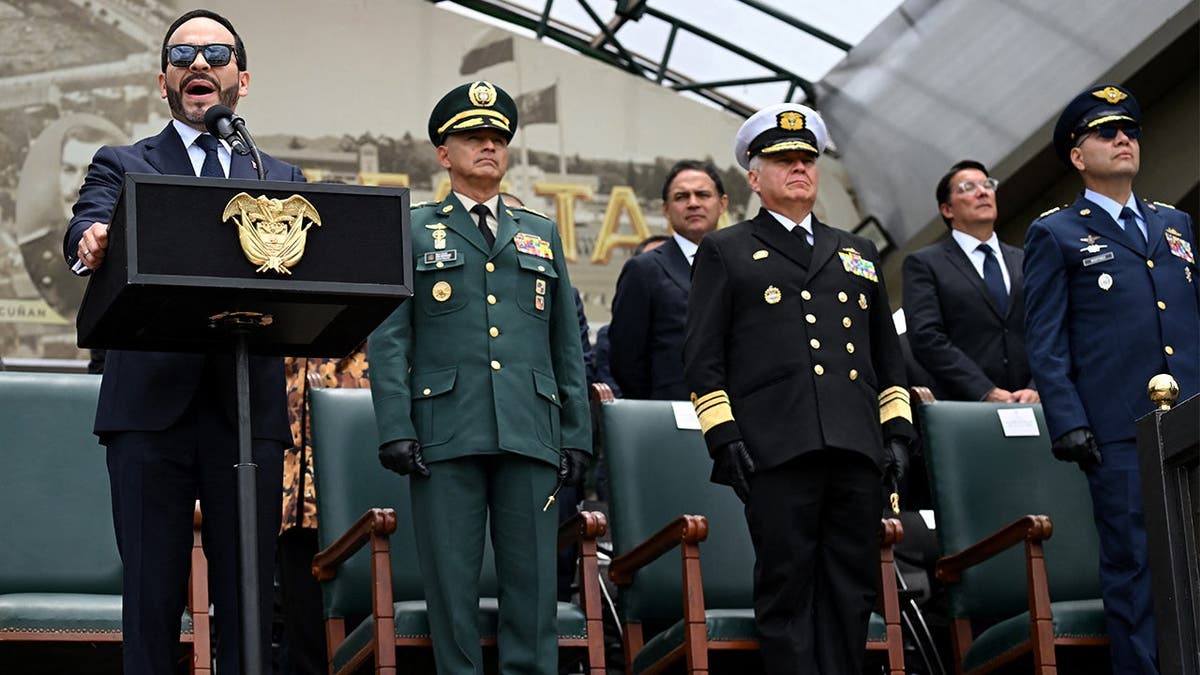
President Abelardo de la Espriella of Colombia has taken a strong stance against cartels in his country. Known as ‘El Tigre’, he was elected on promises of law and order. His efforts in curbing cartel influence are showing results both in Colombia and in Washington.
In a recent operation, 587 police officers and soldiers raided 50 locations in Barranquilla and its suburbs. This action, dubbed Operation Blindaje 360, led to the arrest of 72 individuals. A recording of ‘Keko’, a gang leader, mocking de la Espriella’s efforts had surfaced days prior. The president’s response was swift; he tracked down Keko and confronted him, capturing the moment on video.
De la Espriella, during a speech at the Jose Maria Cordova Military School, emphasized his government’s tough stance against guerrilla fighters, drug traffickers, and other criminal elements. He plans to classify these groups as terrorists, a departure from the previous administration’s approach.
The new administration seeks to reverse former President Gustavo Petro’s ‘total peace’ policy, which included negotiating with armed organizations. De la Espriella has annulled these talks and labeled armed groups as terrorists. In his first three months, his administration reports 32,000 arrests and numerous criminal operations dismantled.
A dual U.S.-Colombian citizen, de la Espriella aligns closely with the U.S., engaging in anti-cartel initiatives spearheaded by former President Donald Trump. Recently, he extradited a guerrilla leader tied to the Sinaloa Cartel to the U.S. and has signed over 100 extradition orders.
Colombia joined Trump’s Shield of the Americas coalition, pledging cooperation with the U.S. on anti-terrorism operations, while maintaining national control over military actions. The U.S. has promised $1 billion in security aid, pending congressional approval.
Security expert Benjamin Gedan notes that the longstanding partnership between the U.S. and Colombia is pivotal. However, he suggests that a more nuanced strategy is needed, as military actions alone may not dismantle well-funded, armed criminal groups.
Oscar Palma from the University of Rosario points out the ongoing debate on whether this aggressive stance brings more safety. He argues that a balance is needed between military action and dialogue, referencing past successful strategies.
Vice President José Manuel Restrepo expressed to Fox News that preserving democracy in the region will benefit from the cooperation under the Shield of the Americas initiative.