
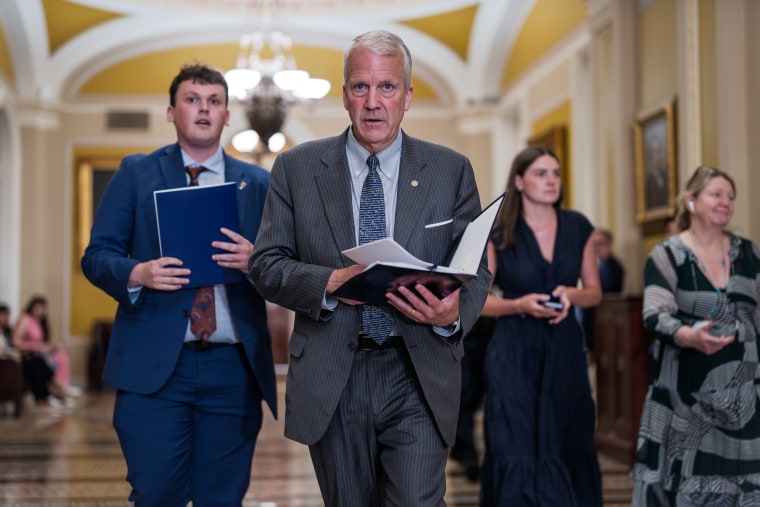
A man named Dan Sullivan, sharing the same name and party affiliation as Alaska Republican U.S. Senator Dan Sullivan, has contested the decision by a state elections official to disqualify him from running in the August primary ballot. The challenger is supported by attorneys who argue that the disqualification violates state and federal laws. They have requested the challenger be reinstated on the ballot.
The challenger, a retired teacher from Petersburg, insists on his eligibility for the U.S. Senate race. His legal team, comprising Jeffrey Robinson, Bryn Pallesen, and Zoe Eisberg, argues that the U.S. Constitution specifies only three qualifications for Senate candidates concerning age, citizenship, and residency.
There are no restrictions in Alaska law concerning the private motivations prompting individuals to run for office.
His entry into the race shortly before the filing deadline led to criticism from Sen. Sullivan and the National Republican Senatorial Committee, who labeled him as a sham candidate working with Democrats to enhance the chances of Democratic former U.S. Rep. Mary Peltola. Peltola’s representatives and state Democrats denied these claims, as did the challenger.
Both Sen. Sullivan and Peltola are significant contenders in a race featuring more than a dozen candidates, viewed as key to both parties’ aim to gain Senate control. According to Steve Kirch, a spokesperson for the division, the agency refrains from discussing ongoing investigations and related proceedings. Ballots are expected to be printed shortly, as noted by Beecher.
Alaska Department of Law spokesperson Sam Curtis indicated the agency’s readiness to uphold the division’s decision and anticipates a swift court resolution. Disqualification proceedings commenced following Republican Lt. Gov. Nancy Dahlstrom’s inquiry into the challenger’s campaign. Beecher concluded that his candidacy did not represent a genuine bid for the Senate but aimed to confuse voters and undermine ballot neutrality.
In her investigation announcement, Dahlstrom referred to accusations of collusion between Sullivan and another candidate with the intention to confuse and mislead voters. Yet, Beecher, in her decision to eliminate the challenger from the ballot, found no evidence of coordination with Peltola or her associates.
In a past interview, the challenger rejected any contact with Peltola’s campaign, affirming “zero, none, zilch.” Beecher’s decision was informed by his voting registration under Daniel J. Sullivan Jr. and his subsequent change to Republican affiliation. Additionally, similarities between his and the senator’s campaign websites and his association with a consultant known for working with Democrats contributed to the decision.
Alaska congressional candidates specify their preferred name and party affiliation on the ballot application form. Beecher invoked regulations prohibiting ballot names that confuse voters or compromise fairness.
Democratic state Rep. Andrew Gray sought clarification from legislative attorney Andrew Dunmire, who stated Beecher’s regulation does not prohibit adding Sullivan’s name to the ballot. Dunmire suggested distinguishing between the two Sullivans on the ballot is possible.
This sentiment is reinforced by Sullivan’s legal representatives. Initially, the state’s candidate list certified him as Dan J. Sullivan while the senator appeared as Dan S. Sullivan with the title of incumbent.
Alaska’s open primaries allow top candidates, irrespective of their party, to proceed to a ranked-choice general election.