
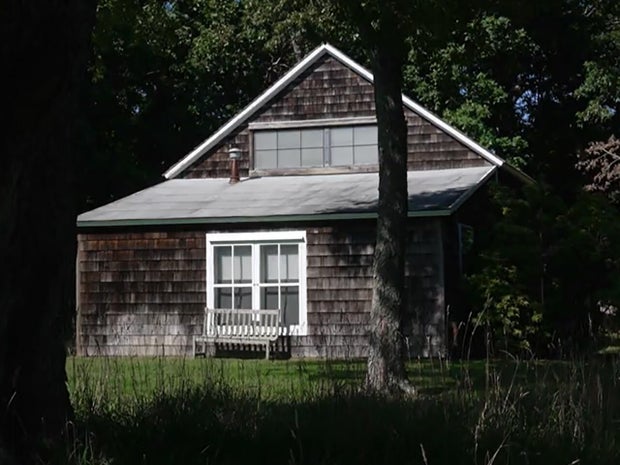
An iconic farmhouse in the small town of Springs, N.Y., is where the Pollock-Krasner House and Study Center stands. Situated on the east end of Long Island, this location became the residence and creative space for Jackson Pollock and Lee Krasner from the winter of 1945. They sparked a transformative movement in the art world known as Abstract Expressionism.
The Pollock-Krasner House, now a historical site managed by Stony Brook University, remains largely unchanged since Krasner’s passing in 1984. Matthew K. Ward, the Center’s director, highlighted their decision to isolate themselves in this rustic house, which lacked plumbing and heating, to concentrate on their art. Among the unique features is a paint-covered speaker system that Pollock installed himself.
In the studio, Krasner worked in a modest upstairs room overseeing Accabonac Creek, while Pollock painted on the barn floor without using an easel. Ward explained Pollock’s method, describing it as physical and dynamic, with paint dripped and splattered onto horizontally placed canvases, leaving the floor itself a masterpiece. Ward remarked that Pollock’s influence is still felt through the very floorboards.
This barn became the epicenter of significant art transformations. In a 1949 Life magazine article, Pollock was posed as possibly the greatest living painter in the U.S. The current exhibition, “Krasner and Pollock: Past Continuous” at the Metropolitan Museum of Art in New York City, finally spotlights both artists’ careers in tandem, emphasizing their professional dialogues and mutual influences.
Pollock’s roots trace back to Cody, Wyoming, while Krasner was from a Jewish immigrant family in Brooklyn. Despite their differing backgrounds, they connected on intellectual and artistic levels. Co-curator Brinda Kumar discusses the creative interplay between their works, aimed to highlight this relationship within the exhibition’s layout.
However, their personal lives were complex. Pollock had a turbulent lifestyle marred by alcoholism and infidelity, which Krasner candidly acknowledged. Krasner briefly left for Paris in the mid-1950s. After Pollock’s tragic death in a 1956 car accident, Krasner returned to Springs, fully assuming control of the studio.
This marked a turning point for Krasner, as she expanded her artistic range by occupying Pollock’s barn studio. Her large-scale canvases from that period, like “Through Blue” and “Combat,” characterize a bold and vigorous approach to art.
Over nearly three decades following Pollock’s death, Krasner energized both her career and his legacy while maintaining their shared home full of their memorabilia. As Matthew K. Ward notes, she sought to preserve both her and Pollock’s artistic legacies.
The exhibition seeks to reshape the history that has often overshadowed Krasner’s contributions. According to co-curator David Breslin, the focus is on establishing her as an equal to Pollock in their joint exhibition, “Past Continuous.” This ambitious show is open until January 31, 2027, offering a fresh narrative about these pivotal artists.