
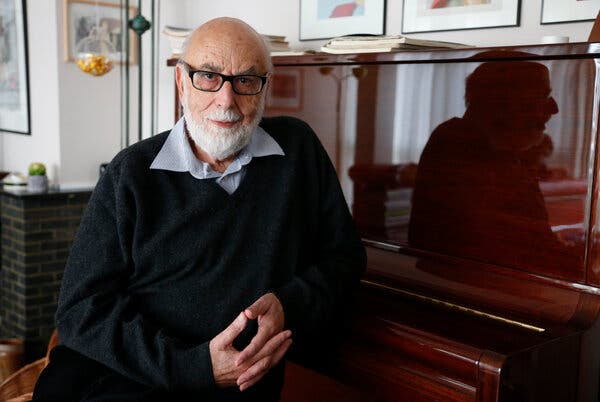
François Englert’s contributions were crucial in the journey to uncover the Higgs boson, a particle that resolved profound questions about how particles gain mass. This achievement remains a cornerstone in the field of physics.
On July 4, 2012, a pivotal event took place at the European Organization for Nuclear Research, or CERN, where scientists awaited the results of two critical experiments. These experiments sought to detect the Higgs boson, a fundamental particle pivotal to physics, often referred to as “the God particle.” The identification of this particle would confirm the existence of a field that assigns mass to other particles, such as electrons and quarks.
“I think we have it,” announced Rolf-Dieter Heuer, who was CERN’s director general at the time, to an audience of enthusiastic scientists.
Peter Higgs, the English physicist after whom the particle is named, was among the audience. He was visibly moved by the announcement, wiping away tears. Accompanying him was François Englert, a Belgian physicist instrumental in developing the theory behind the Higgs field. This theory is a fundamental component of the Standard Model of particle physics, a framework from the 1970s that categorizes all known basic particles and forces, regarded as a hallmark of scientific achievement.
In 2013, Dr. Higgs and Dr. Englert received the Nobel Prize in Physics. Their award recognized their “theoretical discovery of a mechanism that contributes to our understanding of the origin of the mass of subatomic particles.”
Dr. Englert passed away on Thursday in Uccle, Belgium, at the age of 93. CERN publicly announced his death on its website.
Dr. Englert’s early work in the late 1950s at Cornell University with Robert Brout opened avenues to understanding critical issues in physics. They drew inspiration from the work of Yoichiro Nambu, a Japanese American physicist, who had made headway in solving the problem of symmetry breaking in subatomic reactions.