
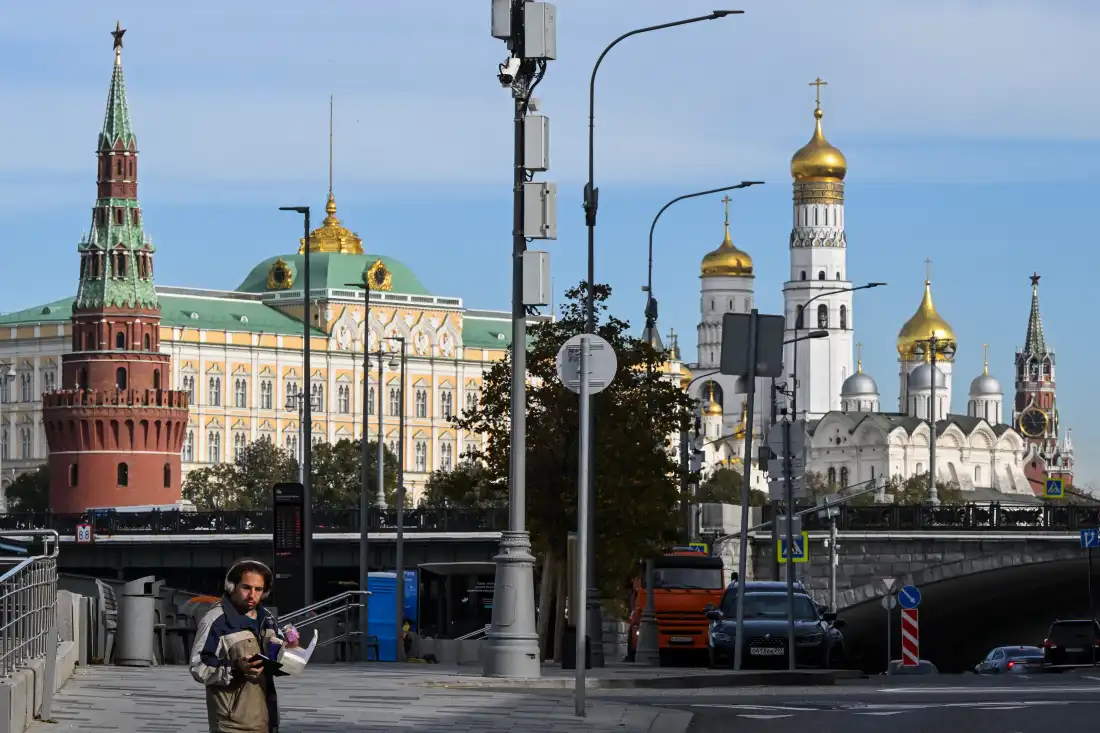
A pedestrian checks his smartphone on a Moscow embankment with the Kremlin in the background on October 8, 2026. Researchers monitoring online influence operations report that Kremlin-backed groups are reviving methods used to sow distrust in previous elections in the U.S. and globally. These operatives disseminate false claims about Democratic candidates, produce AI-manipulated celebrity videos, and create counterfeit posts impersonating legitimate news outlets, all aimed at swaying American voters as Election Day approaches.
Rep. Jim Himes of Connecticut noted the chaotic state of current online operations, describing it as akin to a ‘carnival.’ The objective, he states, is to deepen societal rifts, undermine democratic trust, and crucially weaken U.S. support for Ukraine.
“At the end of the day, the main issue for Russia is and has to be Ukraine,” said Darren Linvill, co-director of Clemson University’s Media Forensics Hub, who has been monitoring foreign propaganda efforts for years. Linvill explains that the Russian strategy involves disseminating false claims on social media or fake news websites, hoping these narratives will spread through state media, fake accounts, or paid influencers. These tactics mirror influencer marketing strategies in the commercial sector.
This methodology was recently employed in a Russian operation that spread an unfounded accusation against a Democratic U.S. Senate candidate. Linvill and other researchers associate this activity with a group dubbed Storm-1516, notorious for producing fake videos with actors, propagating their content through influencers with substantial followings. Using AI, they modify real actors’ faces to impersonate others, complicating the content’s authenticity.
Two such deceptive videos surfaced on social media platform X, from a newly created account purporting U.S. origins. The videos, analyzed by Graphika, were crafted with artificial intelligence and initially lacked traction until distributed by bot accounts, achieving hundreds of thousands of views in short order. X later suspended the initial posting account along with accounts that amplified these deceitful videos.
This pattern of activity mirrors efforts from the 2024 presidential election, where false allegations were also fabricated against Democratic and Republican candidates. Russian operatives, according to Linvill, aim to bolster existing narratives that already circulate within the American populace, reinforcing pre-existing beliefs:
“It is hard to persuade anybody of anything, ever,” Linvill said. “But what you can do is reinforce beliefs.”
In the current electoral cycle, Russia has also disseminated misleading information regarding U.S. political support shifts and baseless corruption allegations against Democratic figures. Lisa Kaplan, founder of threat intelligence firm Alethea, likens Russian intervention to dark money political action committees, subtly influencing public opinion without overt visibility.
U.S. intelligence suggests Russia’s election meddling disfavors candidates supporting Ukraine, irrespective of political affiliation. Despite foreign efforts to sway voter sentiment, there is no evidence of interference in voting mechanisms.
Russian misinformation campaigns have been active beyond the U.S., targeting recent elections in France and Germany among others. According to Graphika, they employ AI-generated media to clone public figures and media entities to disrupt electoral integrity internationally.
Experts predict continued efforts to spread disinformation surrounding voting and ballot processing as election day nears. This strategic focus on contentious issues seems more directed at inciting agitation or apprehension rather than shifting political perspectives.
The article’s original research contribution comes from NPR’s Eric McDaniel.