
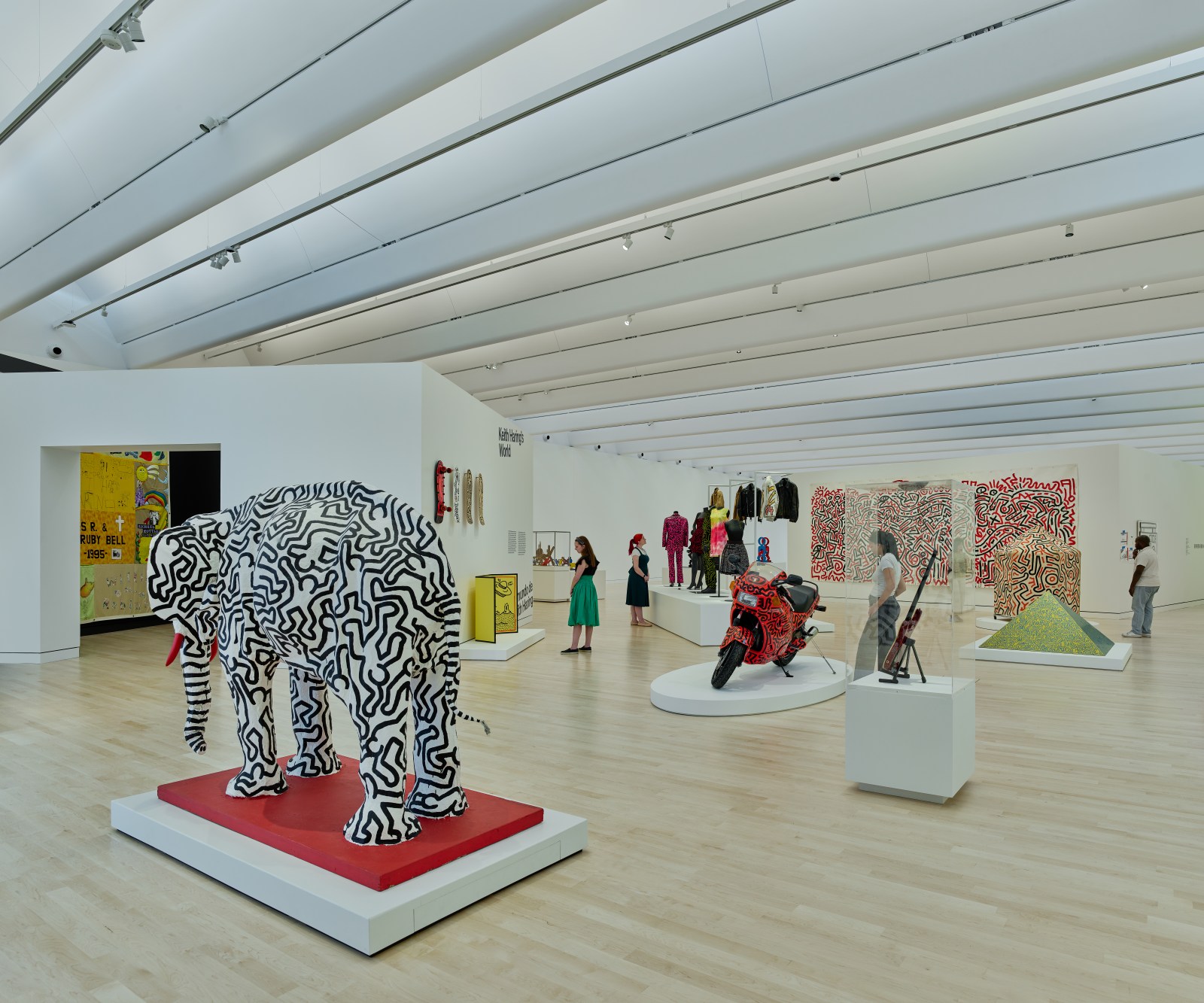
Larry Warsh’s journey as a collector began early, and his latest focus is on Keith Haring’s unique ability to transform lines, objects, and public spaces into a shared language. Warsh is the co-editor of the art book Keith Haring in 3D, which complements a major exhibition at the Crystal Bridges Museum of American Art. This exhibition, held in Bentonville, Arkansas, from June 6, 2026, to January 25, 2027, is the first significant display of Haring’s three-dimensional work.
The exhibition showcases a diverse array of Haring’s art, including sculptures, totems, masks, painted objects, clothing, boomboxes, and even a 1963 Buick Special. These pieces illustrate how Haring’s practice extended beyond traditional two-dimensional art forms.
Finding a Way Into Art
Larry Warsh’s relationship with art began with a tactile appreciation. He grew up in a household filled with visually intriguing objects. His uncle played a pivotal role by taking him to galleries and auction houses at the age of 12. This exposure highlighted how objects could embody history, taste, and energy.
Warsh’s collecting began long before his involvement in the downtown New York art scene. He initially collected antiques, silver, and baseball cards. Moving to Astor Place in the 1980s placed Warsh in proximity to influential artists like Keith Haring, Jean-Michel Basquiat, and Kenny Scharf. This environment helps explain the significance of the Crystal Bridges exhibition, which situates Haring’s object-based work within the vibrant downtown networks that influenced it.
“Collecting has always been instinctual for me,” Warsh notes. “It involves looking ahead, taking risks, and trusting intuition.” In Haring’s work, he found a compelling force tied to both the artist and the city’s energy.
The Downtown Triangle
The art scene Warsh recalls was both communal and energetic. Haring, Basquiat, and Scharf shared a connection through friendship, close proximity, and the broader downtown ecosystem. Clubs, studios, sidewalks, and galleries interconnected, enhancing the collective creativity.
Warsh reflects on this vibrant scene, mentioning places like Fun Gallery and figures such as Patti Astor. He also highlights contributors like Futura, Rammellzee, Tseng Kwong Chi, and Rene Ricard, who collectively helped shape the cultural identity of downtown New York. Haring was a key part of this dynamic community.
Art for Everyone
For Warsh, Haring’s legacy includes an understanding of scale on both visual and social levels. Haring had a keen sense of his audience, aiming to create images and objects accessible in everyday life. The Pop Shop, which opened in 1986, extended Haring’s public mission by transforming subway art into retail without losing its impact.
This concept is a focal point of the Crystal Bridges exhibition, which showcases how Haring adapted his graphic style into tangible, interactive forms. Warsh likens Haring’s approach to earlier artists like Andy Warhol and Salvador Dalí, who understood how art could resonate through public culture while maintaining its force.
Haring’s view on making art accessible is reflected in his own words: “The Pop Shop makes my work accessible. It’s about participation on a big level.” Warsh acknowledges that alongside museums, books, products, and public collaborations have also broadened Haring’s audience.
Discussing Haring’s found-object works, Warsh emphasizes the practicality and resourcefulness of painting on available surfaces like refrigerators and doors. Crystal Bridges underscores this by revealing how Haring transformed ordinary materials into artistic surfaces.
Generosity as Legacy
According to Warsh, generosity is a core component of Haring’s legacy. Many artworks in exhibitions come from friends who received them as gifts. Haring’s foundation extends this generosity by supporting AIDS care and children’s education.
Warsh recalls Haring as an artist deeply engaged with people. His openness and generosity were evident as he painted in hospitals, donated art to benefit auctions, and maintained an extraordinary level of openness. “He was an extraordinarily giving person,” Warsh says.
The Crystal Bridges exhibition highlights how Haring’s sculptures and objects, often overshadowed by his murals, prints, and paintings, offer a fuller understanding of his artistic vision. Haring’s approach was always expansive, engaging, and physically dynamic, challenging the limited narrative of his work’s impact.