
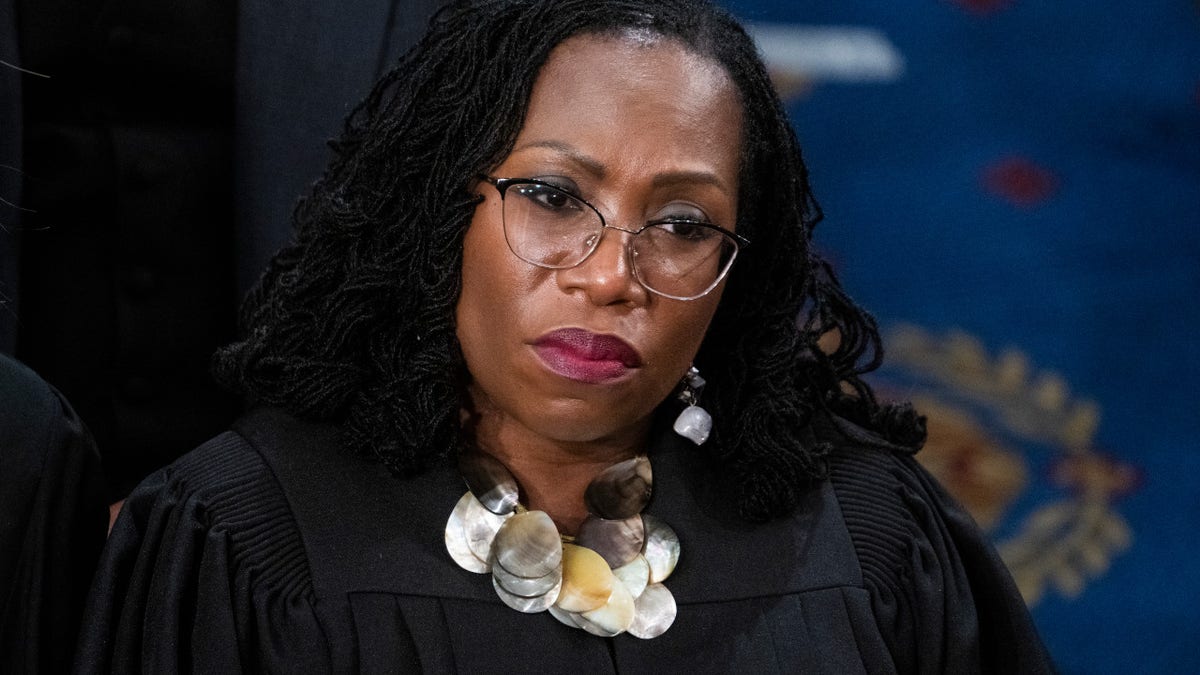
Justice Ketanji Brown Jackson voiced her disagreement with the Supreme Court’s application of a recent decision involving the Louisiana gerrymandering case. The Court’s approach aims to guide lower courts on defining the Voting Rights Act, a move potentially detrimental to past successes for voting rights advocates.
On Monday, the Supreme Court remanded a Mississippi case back to the U.S. District Court for further deliberation following the ruling in Louisiana v. Callais. This ruling dismissed race-based gerrymandering concerns.
“This case presents only the question of Section 2’s private enforceability, which our decision in Louisiana v. Callais did not address,” Justice Jackson dissented, referring to Section 2 of the Voting Rights Act. “Thus, I see no basis for vacating the lower court’s judgment.”
Last month, the Supreme Court narrowed the interpretation of Section 2 of the Voting Rights Act. This section governs how states create districts impacting minority voters, influenced by the Louisiana v. Callais verdict.

Louisiana v. Callais raised the issue of whether Louisiana’s 2024 congressional map, which involved an additional majority-Black district, represented an unconstitutional racial gerrymander. The justices noted that adherence to the Voting Rights Act might be regarded by states as a valid interest in redistricting. However, they didn’t mandate Louisiana to establish another majority-Black district, agreeing with a lower court’s restriction against the state’s map.

In response to the Supreme Court’s decision, Judge panels declared their intention to redraw the Louisiana congressional map if lawmakers failed to do so.
The Supreme Court’s ruling is likely to stir a fresh set of legal disputes concerning congressional boundary lines. The decision raises the burden for complainants to establish evidence of racially discriminatory intent.