
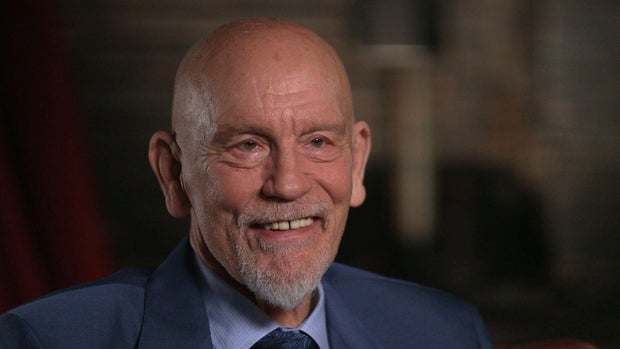
John Malkovich is a unique presence in the film industry. Every role he takes on features his distinctive style, although, at 72, the soft-spoken grandfather often plays characters far from his real persona. Consider his notable roles like Cyrus the Virus in “Con Air,” the seductive Valmont in “Dangerous Liaisons,” and the assassin in “In the Line of Fire.” His performances over five decades remain nuanced and enigmatic—a craft even Malkovich himself cannot fully explain.
We met Malkovich at the Cherry Lane Theatre in Greenwich Village, where he first performed in New York City in 1982. At 28, he had arrived from Chicago’s Steppenwolf Theater Company to star in Sam Shepard’s “True West,” alongside Gary Sinise. Malkovich recalled, “Sometimes on Saturday night, just to amuse Gary, I’d get a six-pack and chug them right there from the fridge.” The performance as Lee, a bully in Shepard’s dark comedy, quickly became the talk of the town.
John Malkovich: “Every night, Antonioni or Mick Jagger or David Bowie would be in the audience. You’d look out and see Jackie O. It was wild.”
This stage success propelled Malkovich into film. His performance as a blind World War I veteran in “Places in the Heart” earned him an Oscar nomination. Early in his career, Malkovich was known for his instant immersion in roles, requiring minimal preparation.
Malkovich later found himself returning to theater for the live and complete storytelling experience it offers, unlike the out-of-sequence scenes typical in films. His notable stage work includes “Death of a Salesman” with Dustin Hoffman and the original “Burn This” in 1987.
This commitment to theater set him apart, even prompting director Stephen Frears, after seeing him on stage, to question why Malkovich wasn’t as compelling in films. They implemented these insights into the making of “Dangerous Liaisons,” which featured Malkovich as Vicomte de Valmont. Malkovich found the adaptation by Christopher Hampton superb, noting the stellar characters.
He played various roles with precise execution, such as the assassin in “In the Line of Fire,” earning another Oscar nod, and a distinct villain in “Con Air,” a blockbuster success. Despite his rich and intellectual background—designing fashion, producing wine, and collaborating musically—Malkovich is not selective based on genre. Both blockbuster and arthouse films offer experiences he values.
Malkovich’s career faced challenges, such as losing his savings to Bernie Madoff’s Ponzi scheme. He recalled the moment of realization and adopted a pragmatic outlook, choosing to move forward and adapt to circumstances.
Malkovich grew up in Illinois, born to a conservationist father and a family that owned a local newspaper. Despite an inconspicuous upbringing, his natural talent shone through, and he rose to fame with unforgettable projects like “Being John Malkovich.” Initially, he resisted the film’s concept but trusted the creative direction of Spike Jonze and Charlie Kaufman, which resulted in a distinct and surreal cinematic journey.
Another standout role was in the Coen brothers’ “Burn After Reading,” and most recently, “Wild Horse Nine,” a film set in a politically charged era on Chile’s Easter Island. Malkovich plays a CIA agent conflicted by past actions, a role that aligns with Martin McDonagh’s blend of dark themes and sharp dialogue.
The film has garnered praise at international festivals, and there is speculation about Oscar potential. Whether or not he wins, Malkovich reflects on his technique with humility, acknowledging an intuitive understanding of acting that he cannot articulate or teach.