
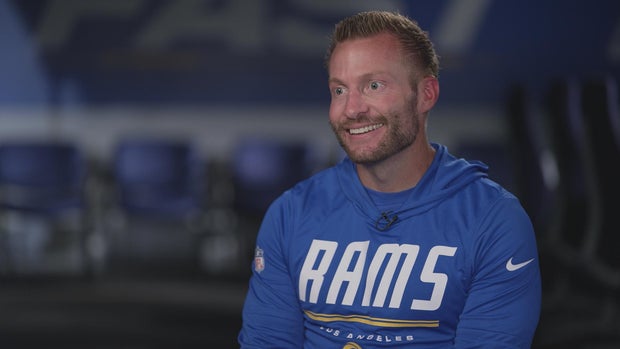
The upcoming Super Bowl is set to take place in Los Angeles, and the odds suggest it might be a home game for the Los Angeles Rams. The Rams, a premier NFL team, are known for their combination of careful planning and bold strategies. They balance change with consistency and strength with intelligence. At the center of this operation is their head coach, Sean McVay.
McVay became the youngest head coach in NFL history a decade ago and has since proven to be a formidable talent, drawing comparisons to legends like Vince Lombardi, Don Shula, and Bill Belichick. However, McVay admits that the pressure comes with challenges. He often feels tormented by the high expectations placed upon him and his team.
During a recent practice session, McVay’s dissatisfaction was evident, reflecting his high standards. Although the practice seemed ordinary to outsiders, McVay’s focus was elsewhere, concerned with improving performance. He acknowledged feeling uneasy due to the burden of his thoughts on the practice.
The Rams have built a formidable team featuring quarterback Matthew Stafford, the NFL’s reigning MVP, and Myles Garrett, considered the best defender in the league. Aaron Donald, historically one of the best defensive linemen, also returned from retirement to strengthen the team. McVay’s objective remains clear: to secure victories on the field.
Sean McVay emphasizes growth over external narratives, focusing on the team’s journey rather than the end result. This mindset contrasts sharply with the situation when the Rams returned to Los Angeles from St. Louis. Les Snead, the general manager, needed a turning point during those years, leading to the bold move of hiring McVay, who was an unproven but promising figure.
Under McVay, the Rams’ offense thrived through innovative strategies that increased the team’s scoring opportunities. In his debut season, McVay led the Rams to the playoffs and earned the Coach of the Year title. His play-calling prowess is rooted in his exceptional memory, allowing him to recall crucial details and adapt effectively. This ability to remember is not just a trait but a tactical advantage.
McVay was a star quarterback in high school but shifted toward NFL management after college due to injuries. His rise was quick, becoming an offensive leader in Washington by age 27. At the Rams, McVay’s strategy focuses on exploiting opponents’ defenses through detailed analysis and creativity.
Rams quarterback Matthew Stafford explained that success involves understanding defensive setups and creating situations that challenge those formations. When these efforts align perfectly, there’s a great sense of accomplishment. McVay communicates directly with Stafford through a headset during games, signaling each play, although Stafford admits he sometimes wishes for a ‘talk back’ button.
In Stafford’s first season in Los Angeles, the Rams reached the Super Bowl. Before the game, McVay and Stafford refined a particular play known as the jet sweep, which contributed to their success. McVay became the youngest head coach to win a Super Bowl, though the victory proved bittersweet. He reflected on the pressures and emotional impact, revealing how success brought temporary happiness and exposed personal insecurities.
Following the Super Bowl win, the Rams experienced a downturn, leading McVay to consider leaving coaching for broadcasting. His wife, Veronika, played a crucial role in reaffirming McVay’s commitment to leadership. McVay acknowledged that quitting would not align with his aspirations as a leader.
The Rams, under McVay, have consistently reached the playoffs, showcasing his growth and adaptability. McVay won his 100th game before turning 40, a testament to his skill and determination. He admits that success involves navigating ups and downs and recognizes the importance of quickly addressing challenges.
The Rams’ demanding culture under McVay emphasizes transparency and accountability. His approach has influenced other teams, with many adopting Rams’ strategies and hiring his former assistants as head coaches. Nate Scheelhaase, one of McVay’s assistants, highlights McVay’s strict standards regardless of practice conditions.
The Rams prioritize close relationships and openness, challenging traditional perceptions of football toughness. Stafford notes the benefits of vulnerability within the team, which McVay’s leadership exemplifies. McVay’s dedication to physical fitness also serves as an inspiration to his players.
Beyond coaching, the Rams’ success depends on the Kroenke family’s ownership, known for significant investments in infrastructure, including the world’s most expensive sports venue, SoFi Stadium. The Rams also leverage advanced technology such as AI in strategizing, complementing McVay’s memory and tactical acumen.
Les Snead emphasizes character over talent when building the team, while Nicole Blake leads AI initiatives to identify game patterns unnoticed by humans. This technological edge could change coaching dynamics in the NFL.
Despite innovations, football remains fundamentally a game of people and strategy. The Rams’ journey reflects perseverance against expectations. Snead’s office features a statue of Sisyphus, symbolizing the ongoing struggle to reach the top.
For McVay, in his ninth season with the Rams, the key lies in how challenges are managed. Understanding these dynamics enhances the team’s chances of success throughout the season.