
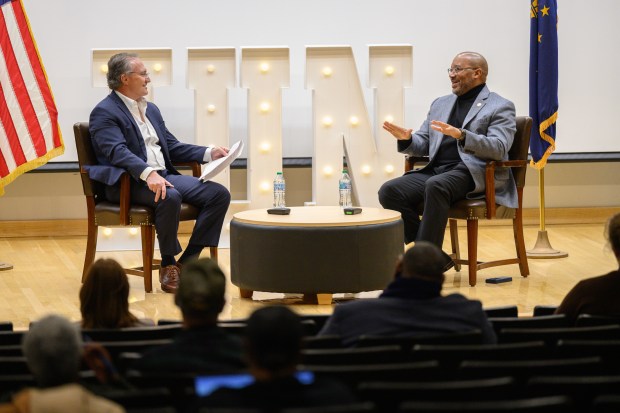
Chancellor Arrick Jackson of Indiana University Northwest shares how his military experience profoundly shaped his career in higher education. He credits military discipline with teaching him how to manage multiple challenges simultaneously. “Persistence, discipline, strategy, and innovation from my military days contribute to my work now,” Jackson remarked.
Jackson engaged in a live conversation with Patrick Russell, founder of the Making History Project, during Veterans Week on November 11, 2026. This organization aims to preserve veterans’ narratives through video interviews, with more than 100 completed since 2015. These interviews are permanently stored in the U.S. Library of Congress.
Jackson shared his background, growing up in Saginaw, Michigan, and why he joined the military. Enlisting in 1987, he served for six years as an airborne officer in field artillery and a noncommissioned officer in military intelligence, attaining the rank of sergeant.
His early life faced challenges; both parents died before he was 9 years old, leaving him to navigate life independently. “By age 9 or 10, I knew I had to make it on my own,” Jackson shared.
Though other relatives served in the military, the influence wasn’t prominent due to the Vietnam War’s aftermath. After graduating high school at 16, his adoptive mother insisted on one year of schooling before enlisting.
“I told my mother I was joining the army and leaving Friday,” Jackson recalled. Her reaction was immediate; she dismantled his bed, symbolizing the transition.
Jackson spoke humorously about the parallels between military life and his mother’s household. Airborne training taught him to jump from planes, an experience he described as “quiet,” despite its dangers. When he expressed a desire to leave his airborne unit, an officer told him, “Quit is not in the vocabulary of an airborne soldier. Get out of my office.”
Jackson enlisted again, focusing on military intelligence with postings in Germany and Korea. His time in Korea led to volunteering at an orphanage and reignited his passion for education. He pursued a doctorate, determined to teach at the college level.
In response to a question about higher education’s role in democracy, Jackson emphasized that education is crucial for societal improvement. His mother instilled a deep respect for learning, fostering civic engagement.
Russell concluded the interview by acknowledging Jackson’s impact, highlighting his contributions to education and society. “Mission accomplished, Dr. Jackson,” Russell noted.