
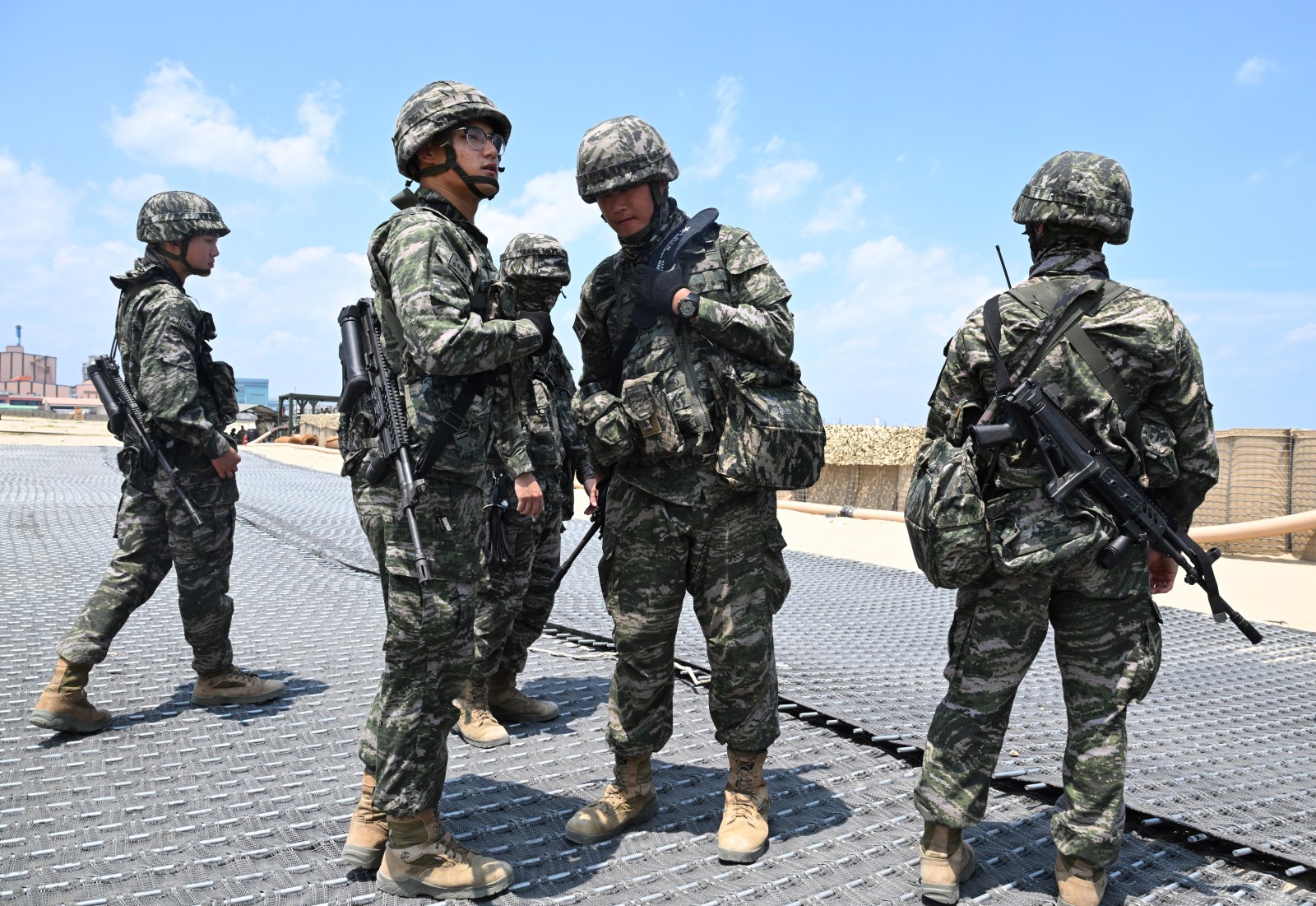
Analysts suggest that Donald Trump’s decision to reduce military drills with South Korea may open the door to renewed discussions with North Korea. This approach presents Washington with an opportunity to negotiate restrictions on Pyongyang’s expanding nuclear arsenal. The U.S. President announced on Sunday that he had directed Defense Secretary Pete Hegseth to scale back the annual U.S.-South Korea exercises, citing his favorable relationship with North Korean leader Kim Jong Un and Seoul’s insufficient support regarding the Iran conflict. Despite these instructions, the scheduled exercises commenced on Monday.
During Trump’s initial term, he engaged with Kim three times in denuclearization dialogues, though these efforts did not yield successful outcomes. Since those meetings, North Korea has continued to enhance its nuclear capabilities, building about 60 nuclear weapons and possessing enough fissile material to produce at least 30 more. This data comes from a report published in June 2026 by a Stockholm-based think tank. Earlier this month, Pyongyang conducted United Nations-banned ballistic missile tests.
The recent announcement made by Trump on Truth Social has raised concerns among Democrats, Republicans, and South Korean officials, fearing that this move might empower Pyongyang and undermine the credibility of Washington as a reliable ally amid challenging geopolitical circumstances. However, Evan Sankey, a policy analyst from the Cato Institute, remarked that this decision poses the possibility of reigniting U.S.-North Korea negotiations. He acknowledged that while there is limited chance to persuade Kim to abandon his nuclear weapons, discussions might establish limits on his missile arsenal and fissile material stockpiles.
Jennifer Kavanagh, director of military analysis at Defense Priorities, regarded Trump’s announcement as a necessary and strategically sound decision aligning with U.S. interests. Newsweek has reached out to the White House and the South Korean foreign ministry for their comments.
The U.S.’s Close Ties with South Korea
South Korea hosts Camp Humphreys, the largest overseas American military installation, and the nations conduct regular joint military exercises. The annual Ulchi Freedom Shield drills started as planned and, according to Reuters, will focus on countering North Korea’s developing capabilities, including training against drones, GPS jamming, and cyberattacks. Local authorities report that at least 18,000 South Korean troops participated.
North Korea has been critical of these exercises, labeling them as preparations for an aggressive war. Trump stated on Truth Social that these drills send a ‘hostile’ message to North Korea, which he characterized as ‘unthreatening and respectful,’ sparking strong reactions. Senator Jack Reed, the leading Democrat on the Senate Armed Services Committee, commented that emphasizing military exercises appears to placate a dictator. Republican Senator Thom Tillis claimed that Trump’s announcement provides North Korea’s troops with freedom to support Russia’s military endeavors.
Meanwhile, the South Korean newspaper Hankook Ilbo noted Trump’s declaration revealed the frail state of the Korea-U.S. alliance. Sankey from CATO commented that Trump’s move is reminiscent of prior negotiation rounds with Kim in 2018 and 2019. He indicated the lack of current U.S.-DPRK talks but suggested scaled-back exercises might herald a U.S. diplomatic initiative. Kavanagh remarked that there is scant proof drills with South Korea deter aggression from North Korea and China, suggesting they may even promote regional instability.
Rather than being deterred, China and North Korea often intensify their military build-ups and regional activities, sometimes engaging in military exercises or new weapons tests.
South Korea’s Pursuit of Security Control
Exercises with South Korea drain U.S. resources and readiness, already strained by the war in Iran, Kavanagh noted. She suggested that the U.S. should allow South Korea to assume complete responsibility for its security. On Tuesday, South Korean President Lee Jae Myung renewed his campaign to finalize the transfer of wartime operational control of South Korean forces from the U.S. to Seoul. Additionally, he called for faster progress in obtaining nuclear-powered submarines. This issue traces back to the Korean War, which concluded with an armistice instead of a formal peace treaty in 1953.
Sankey from CATO concluded by saying that talks between Washington and Pyongyang might also lead to a proclamation ending the Korean War, asserting that such developments would benefit U.S. interests and justify diplomatic efforts.