
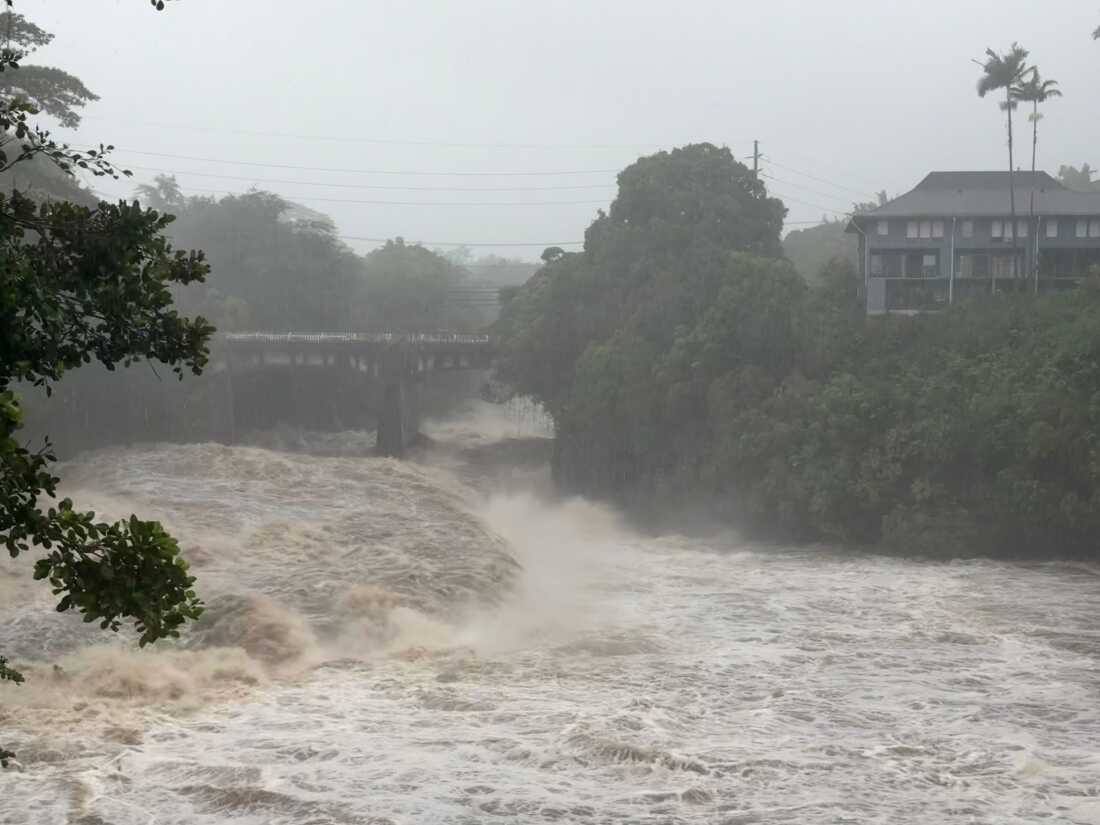
The Wainaku Street Bridge in Hilo on the Big Island of Hawaii bore witness to rising water levels on the weekend of August 15, 2026. Hurricane Lala downgraded to a tropical storm by Sunday after narrowly bypassing Hawaii without making landfall. Despite the downgrade, the Big Island endured hurricane-force winds.
Officials anticipated nearly three feet (one meter) of rain on the windward slopes. This precipitation risked turning rivers into torrents and causing mudslides. As of Sunday, tropical storm conditions spread from Maui to Oahu and then Kauai. The National Hurricane Center indicated that wind speeds at higher elevations can be up to 30% stronger than those measured near the surface.
Wave after wave battered the Big Island’s coast while Lala moved at a slow pace. Strong winds bent palm trees and rain-driven runoff filled waterways. Over 130,000 households across Hawaii’s three largest islands lost power, according to poweroutage.us.
Governor Josh Green reported several hospitals using generators. A tragic car accident on the Big Island’s South Point area took one life, and wind stripped 19 roofs from homes. As of Saturday evening, the storm had affected numerous roads, with over 30 sites needing attention from maintenance crews.
A search-and-rescue mission involved Civil Defense, the National Guard, and Coast Guard after flash floods displaced homes in Na’alehu and Wai’ohinu, coastal communities near the southern tip of the island.
Hawaii County Mayor Kimo Alameda highlighted the hazards in such operations, including rushing water, road debris, and boulders amidst darkness.
Future Concerns for Lala
Tropical storm warnings remain for Maui, Molokai, Lanai, Kahoolawe, Oahu, Kauai, and Niihau. As Lala moves west, threats of floods and wind-induced wildfires linger. By early Sunday, the storm centered about 105 miles (170 kilometers) west-northwest of Kailua-Kona and 100 miles (160 kilometers) south of Honolulu, with winds extending 175 miles (280 km) from its center.
Lala had winds reaching 70 mph (110 kph), moving northwest at 15 mph (24 kmh). Forecasters predict a return to hurricane strength by midweek, once Lala is far west of the island chain. Estimates suggested up to 35 inches (89 centimeters) of rain on the Big Island’s high-altitude areas. These rains may destabilize slopes housing parts of the off-grid population.
Preparing for the Worst
Shelters opened as Lala approached and events were postponed. Ranchers received advice to keep cattle out in open pastures rather than in potentially unsafe structures. Residents, still recovering from floods in March, adopted a cautious approach.
Bobby Camara, a resident for 75 years, aimed to stay safe in a care home near Hilo, although power outages were a worry. Many filled up on fuel for saws and vehicles, a common practice.
Fire captain Mike Caputo, from Keaau, prepared a generator and filled a 10,000-gallon water tank. He expressed concern over flash floods and weak albizia trees, which could block roads.
Christine Matsuda, from Waimea, shared reports of fierce gusts rattling homes. Many discovered unexpected leaks due to the relentless rain.
The forecast called for 8 to 12 inches (20.3 to 30.5 centimeters) of rain on Maui and lower regions of the Big Island. Across the island chain, 4 to 6 inches (10.2 to 15.2 centimeters) of rain was expected.