
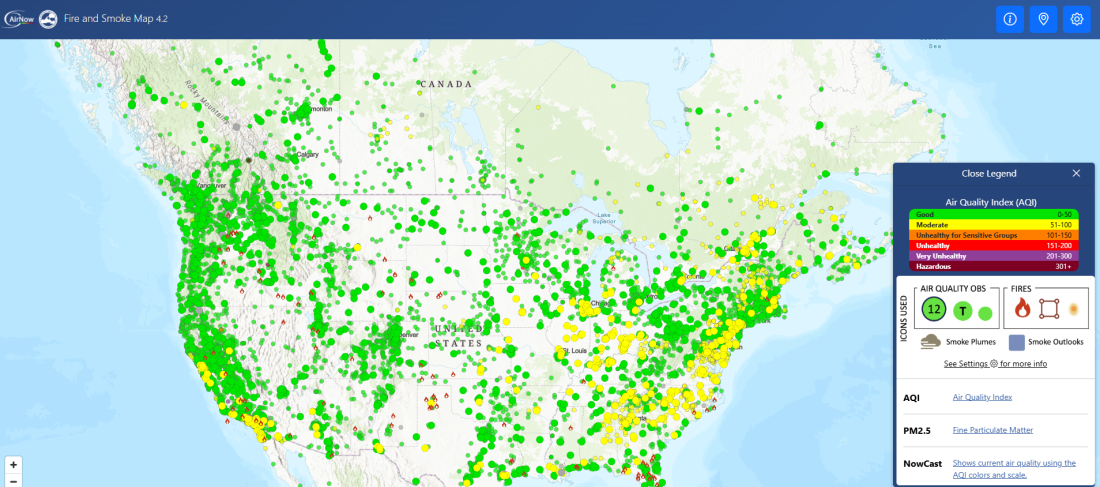
Wildfire and smoke maps available on the federal government’s fire.airnow.gov website stem from research partly funded by the U.S. Forest Service. These tools have grown more relevant as the West braces for a challenging wildfire season. The University of Washington (UW), known for securing substantial federal research funding, finds its environment tense due to President Trump’s cancellations of portions of funding for major science organizations like the National Science Foundation and National Institutes for Health.
The anxiety reaches UW’s less high-profile departments like the School of Environmental and Forest Sciences. Here, impending U.S. Forest Service funding cuts and agency reorganization pose immediate threats. A new summer filled with wildfires emphasizes these concerns. Fire ecologist Ernesto Alvarado from UW’s faculty examines smoke projections on his computer, focusing on areas like New Mexico, where dense smoke might impact those with weakened immunity.
Alvarado and his colleagues from the U.S. Forest Service’s Pacific Wildland Fire Sciences Lab have developed this real-time updated map with help from students and IT staff. Alvarado asserts the urgency of adopting new technology swiftly as governments and firefighting teams widely use these tools. This technology represents decades of accumulated Forest Service knowledge and research.
Worry Over Research Lab Closures
The Seattle smoke lab now faces potential closure, one of 56 out of 90 research stations targeted by the Trump administration’s plan to reorganize the Forest Service. This reorganization involves relocating headquarters and consolidating offices, sparking concern among researchers like Morgan Varner, a former fire behavior scientist at the Seattle lab.
Varner believes few lab employees will relocate. He highlights Seattle’s position as a technology center with significant academic resources, critical to the lab’s location. Yet, Forest Service Chief Tom Schultz defends the plan from his office, pointing out that multiple administrations since 2006 have considered restructuring.
Schultz insists research remains vital, yet he acknowledges a $3 billion backlog in maintenance, where cutbacks could enable fiscal balancing. Schultz suggests some staff might move to nearby state offices, emphasizing employee involvement in the decision-making process.
Concerns Among State Officials
While Schultz reaffirms the importance of science, President Trump’s proposed budget could significantly scale back the Forest Service just as climate change escalates fire risks. Staff reductions have already hit the service hard, leaving Western communities and researchers apprehensive.
In Washington state, Public Lands Commissioner Dave Upthegrove emphasizes the research laboratories’ contributions to wildfire response and public safety. Despite initial optimism, state officials express concerns over dwindling communication from the Forest Service about these reorganizations. As forest conditions become more volatile, ensuring effective fire management and safety remains a priority.