
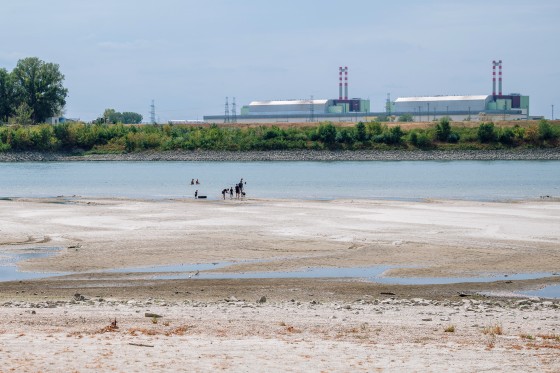
Persistent drought and extreme heat waves have significantly lowered the Danube River, threatening Hungary’s primary source of electricity. Prime Minister Péter Magyar announced efforts to raise the river’s levels to ensure the Paks nuclear power plant remains operational.
On Wednesday, Magyar stressed the urgency of raising the Danube’s water levels. The Paks plant, which relies on the Danube for cooling its four reactors, operates at just over 10% of its capacity due to the low water levels. The plant provides about one-third of Hungary’s electricity. Magyar warned that prolonged low levels could lead to the plant’s complete shutdown.
Strategic Construction to Aid Water Levels
Hungary plans to construct a bed sill near the plant. This structure, composed of 145,000 cubic meters of rock, aims to slow the river’s current and increase upstream levels by up to a meter. Deliveries for the construction commenced on Wednesday evening.
Additionally, two barges, each 262-foot long, are poised for transport to the site. Authorities will decide on Friday if the barges will be sunk to boost the river by another 20 centimeters at the plant’s cooling pumps.
We can no longer consider this extraordinary situation as a one-time natural extreme,
Magyar said, emphasizing the necessity of swift action to prevent a total plant shutdown.
Magyar regards the bed sill construction as a sustainable solution to maintain adequate water levels, preventing future necessary shutdowns.
Impact and Costs
The current reduced output of the Paks plant incurs an economic cost of up to 50 billion forints ($158 million) monthly. In contrast, the interventions on the Danube are estimated to cost approximately 6 billion forints ($19 million).
Last week, Romania faced a similar predicament. Authorities there sank four barges filled with rocks into the Danube to channel water toward the Cernavoda nuclear plant, which had already ceased operations for one of its reactors due to low water levels.
Magyar remarked on Wednesday that the temporary rise in water levels is expected to drop soon. Without the proposed interventions, the Paks plant might face a complete shutdown, further highlighting the critical situation’s immediacy.