
UC San Diego doctors have successfully used $20,000 humanoid robots to perform a remote gallbladder surgery on a pig. This marks a significant development, showcasing the ability of artificial intelligence to tackle surgeon shortages and enhance healthcare accessibility worldwide. Despite the potential benefits, discussions are ongoing regarding privacy issues related to advanced AI robots, including an $8,000 robot designed for household chores.
Meanwhile, researchers at the University of Basel in Switzerland are developing a miniature dental robot, named MIR, to revolutionize dental care. This tiny robot aims to assist in preparing teeth for crowns, potentially reducing the number of dental visits required for crown fittings.
Developments in Dental Robotics
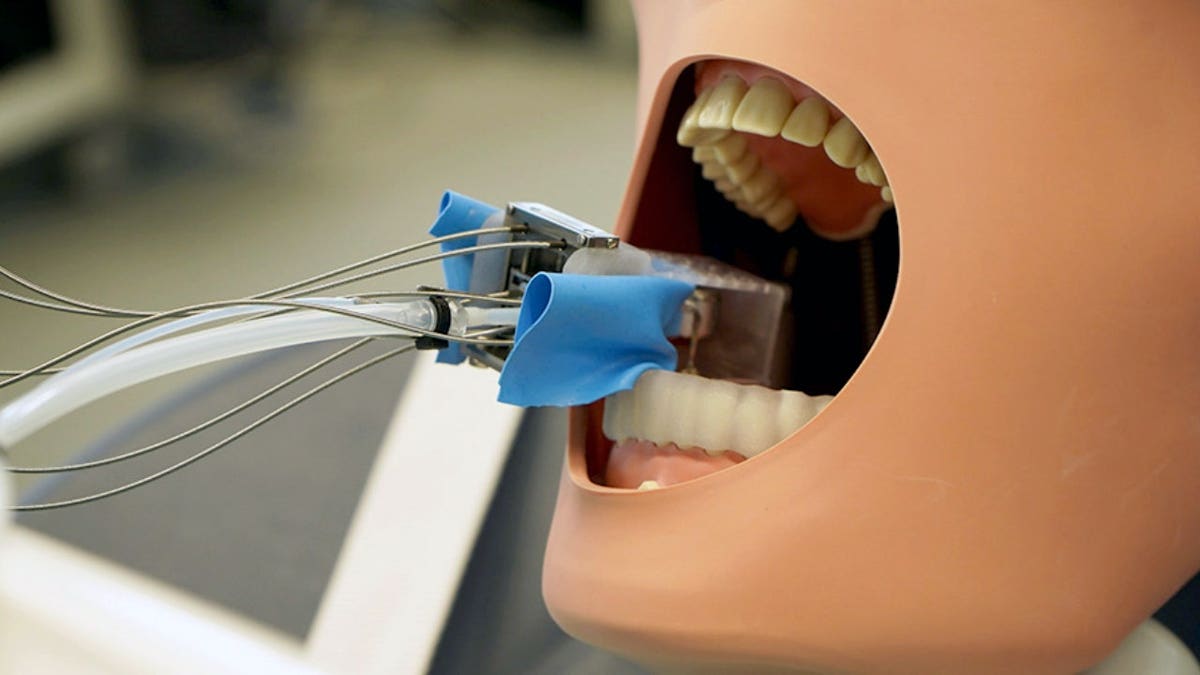
MIR, which stands for Miniature Intraoral Robot, could transform current dental procedures. Typically, getting a crown involves multiple steps: decay removal, cavity filling, tooth shaping, impression taking, and the fitting of a temporary crown. MIR aims to streamline these steps into a more efficient digital workflow.
The robot connects to a custom-fitted dental splint, allowing it to move with the patient if they adjust their head position. This flexibility can significantly ease patient discomfort during dental procedures. The robot follows a digital treatment plan, initially using a wider drill to flatten the tooth surface before a thinner drill shapes the sides.
Size and Functionality of MIR
The MIR prototype measures 43 by 26 by 28 millimeters, comparable to the size of a wine cork. Such a compact design ensures it fits comfortably in an open mouth without obstructing the dentist’s view.
Researchers at the University of Basel envision a fully digital treatment workflow with CAD-CAM dental technology. Although testing is ongoing, MIR has shown precision with positional errors under 0.2 millimeters during simulated procedures on synthetic and ceramic models.
Challenges and Future Prospects
Despite promising results, MIR is not ready for use in dental clinics yet. The next development phase includes adding sensors and a camera for real-time monitoring and positional awareness. These additions are crucial for ensuring patient safety during actual procedures.
Developed through collaborative efforts involving University of Basel, University of Zurich, and other institutions, the MIR project is currently supported by Innosuisse, with research published in IEEE Transactions on Medical Robotics and Bionics.
Potential Impact on Dentistry
MIR’s potential lies in its ability to digitize and simplify the crown-fitting process. While still a prototype, its implementation could lead to faster, more precise dental treatments with fewer visits required.
As the field of dentistry increasingly adopts digital technologies like computer-designed crowns, MIR represents a possible future where dental procedures become more efficient and patient-friendly.