
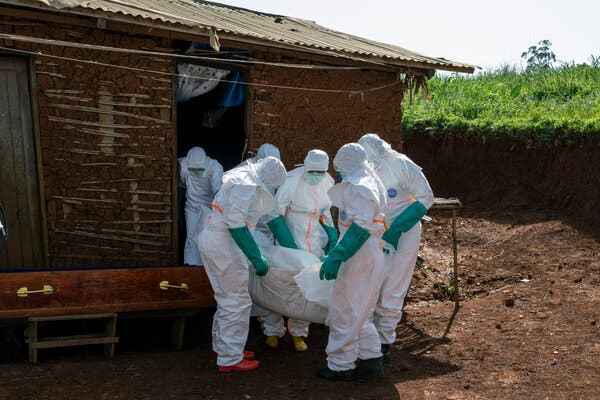
For decades, mining has been a crucial part of life in a secluded Congolese hill town. Recently, it has also been a factor in the expansion of a severe Ebola outbreak. Last week, Red Cross workers, clad in white protective suits, were seen removing the disinfected body of a gold miner named Mumbere Saidi in Mongbwalu, Democratic Republic of Congo.
Located in northeastern Congo, Mongbwalu has become a focal point of this outbreak. The town draws individuals from across the region and beyond for work in the gold mines. Sadly, the prosperity gambling on gold provides comes with risks. Saidi, 27, had previously fled his farm after an attack by a local Islamic State faction. He made the arduous journey of 200 miles to Mongbwalu, one of Africa’s perilous war zones.
In Mongbwalu, Saidi engaged in hard labor, panning for gold. The income was unstable; when fortunate, he managed to send a small sum back to his parents. Otherwise, providing for his wife and infant daughter was a challenge. Still, Saidi felt a sense of security until last week when Ebola claimed his life at home.
“The disease got him,” his brother, Kondu Ganda, stated while referring to Ebola, a term locals often avoid using directly. The Red Cross team’s somber task included removing Saidi’s body and placing it carefully in a coffin.
Mongbwalu, in Ituri province, has relied on gold mining for over a century. However, it now finds itself at the center of an Ebola outbreak. The epidemic, already the third most severe recorded, is believed to have started in the town as early as February. Detection was delayed until May 15 because it involved Bundibugyo virus, an uncommon strain for which no treatment exists.