
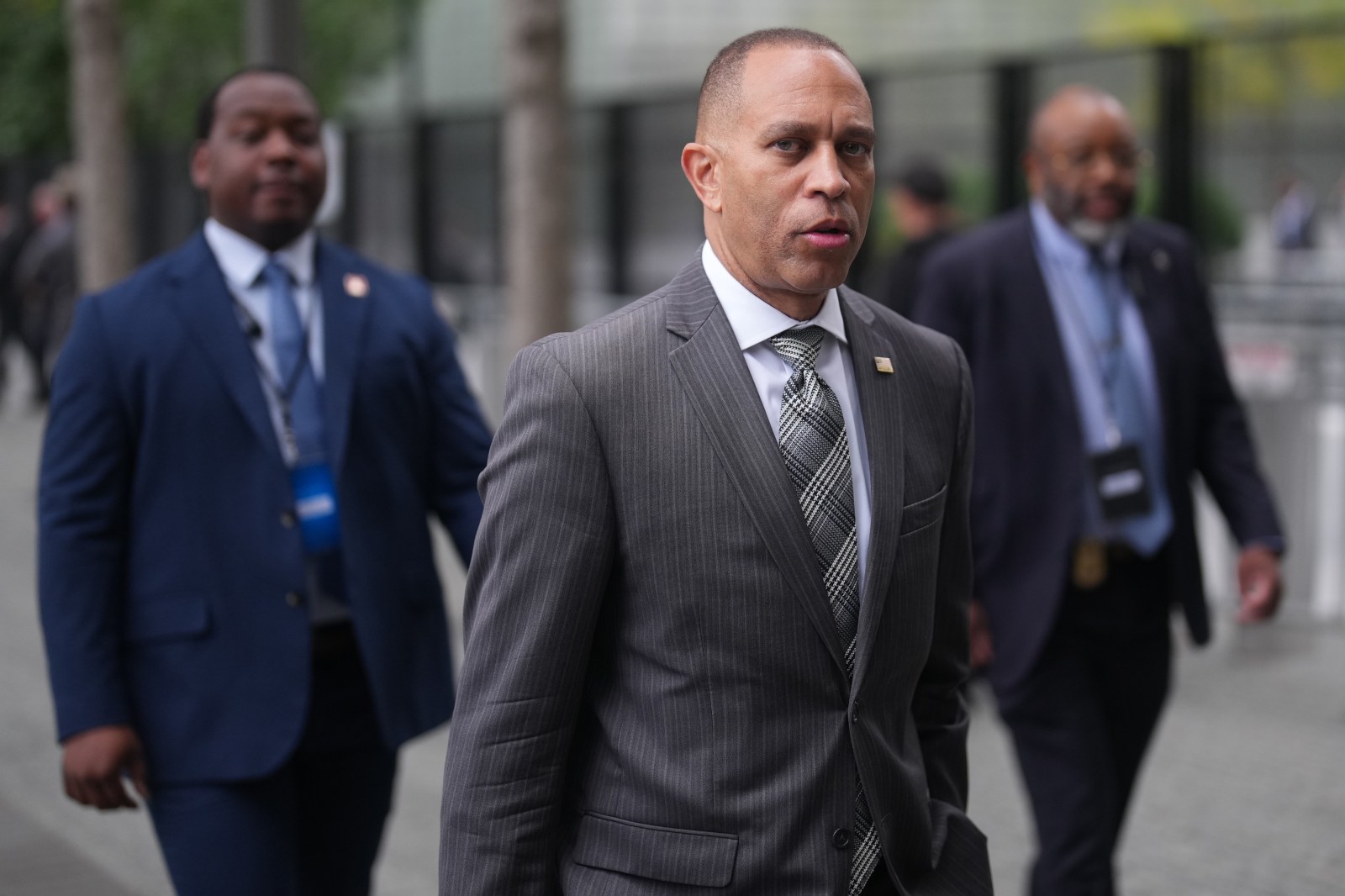
House Minority Leader Hakeem Jeffries endorsed President Donald Trump’s strategy for turning the year’s midterms into a referendum on his administration. Voters are already assessing Republicans based on the president’s performance. At the first-ever Republican midterm convention in Dallas, Trump encouraged his base to see November contests as an extension of his presidency.
“Pretend that I’m on the ballot. I’m on the ballot, just one more time,” Trump declared. Jeffries, during an interview on ABC News’ This Week, adopted this framing. The New York Democrat argued that Trump’s record naturally centers the campaign.
“Mr. President, we don’t have to pretend,” Jeffries told host George Stephanopoulos. “You are actually on the ballot.”
Newsweek sought comment from the White House regarding these remarks.
Expanding the Battleground
Jeffries detailed a wide range of issues that Democrats intend to highlight, linking Republican candidates directly to Trump administration policies.
- Economic performance
- Cost of living crisis
- U.S. involvement in Iran
- Rising gas prices
- Healthcare concerns
- Trade policy
“The Trump tariffs, which have increased costs on everyday Americans by thousands of dollars per year, are on the ballot,” Jeffries stated.
This strategy portrays congressional races as a national referendum on Trump’s return to power. It remains uncertain if it will engage the electorate as effectively as Trump’s effort to energize his base.
Trump’s Midterms Election Strategy
During the midterm convention in Dallas, Trump proposed a controversial idea. He announced a $5,000 payment to every adult American citizen if Republicans maintain control of both Congressional chambers after the midterms.
“Because of our tremendous strength and success economically, I will issue a dividend to every adult citizen in the United States of America for $5,000,” Trump said.
He likened this to a company giving a cash distribution to its shareholders. It remains unclear how the government would ensure the money is spent in the U.S., as no legislation or funding details were provided.
With roughly 270 million adults in the country, the proposal would cost about $1.35 trillion. Congressional approval and administration questions also arise.
House Speaker Mike Johnson, questioned about Trump’s announcement, committed that Congress will work towards consensus, similar to other matters.
Where Trump’s Approval Rating Stands
CNN’s Poll of Polls placed Trump’s approval at 35% with 63% disapproval as of September 1. This average included data from several national surveys conducted between July 22 and August 31. RealClearPolitics showed slightly better figures, with a 39.2% approval and 57.6% disapproval.
The New York Times average mirrored these findings with a 39% approval and 58% disapproval. Silver Bulletin’s model showed a net approval of -19.5. Across these surveys, more Americans disapprove of Trump’s performance than approve.
Specific surveys like the Economist/YouGov and Morning Consult reflect varying approval ratings. Both show differing figures, illustrating why averages give a clearer picture than individual surveys.
What the White House Says
The White House routinely downplays unfavorable polling, citing Trump’s victory in the 2024 election as the ultimate measure of support. White House spokesperson Davis Ingle emphasized Trump’s focus on jobs, inflation, and housing affordability. He affirmed Trump’s accomplishments domestically and internationally.