
Explore significant events in Chicago’s history that took place on October 6, according to the Tribune archives.
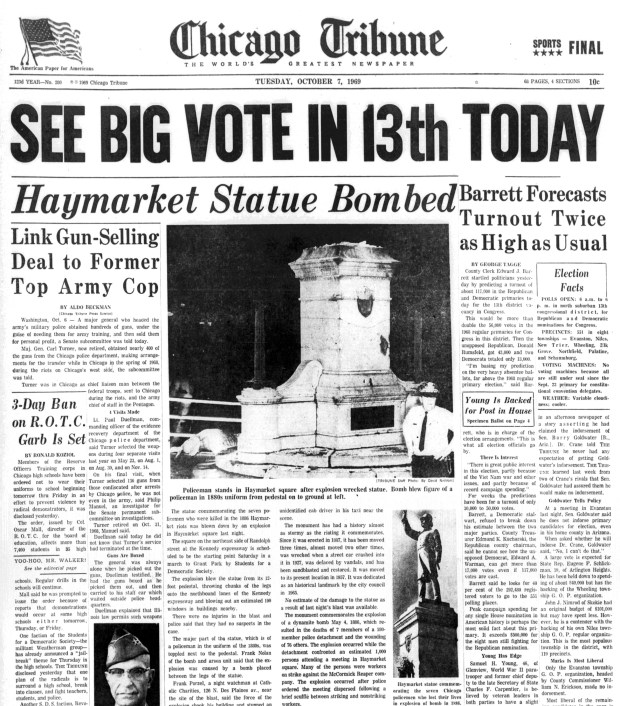
October 7, 1969: Haymarket Police Memorial Bombed
On October 6, 1969, a bomb destroyed the bronze monument dedicated to the seven police officers killed in the 1886 Haymarket Affair. This incident marked yet another challenge for the monument, which had experienced several relocations, vandalism, and even a streetcar collision since its establishment in 1887. According to reports, Weather Underground members took responsibility for the bombing. Mayor Richard J. Daley condemned the act, labeling it disrespectful and an attack on Chicago’s citizens. Today, the restored monument stands outside police headquarters on South Michigan Avenue, while the Haymarket Memorial is located on North Desplaines Street.
Notable Weather Events
Weather data from the National Weather Service reveals some remarkable occurrences for October 6 in Chicago:
- 1963: High temperature recorded at 94 degrees.
- 1952: Low temperature plummeted to 28 degrees.
- 1955: Precipitation reached 1.57 inches.
- 1935: Snowfall registered as a trace.
1818: Inauguration of Illinois’ First Governor
Shadrach Bond became Illinois’ first governor on this day in 1818. In his inaugural address, Governor Bond highlighted the state’s financial woes, noting an empty treasury and damaged credit. He also addressed the harshness of certain criminal penalties, expressing opposition to whipping and confinement in stocks for crimes.
1945: Start of the Curse of the Billy Goat
On October 12, 1945, the owner of the Billy Goat Tavern, Bill Sianis, and his goat, Murphy, were barred from entering Wrigley Field. This led to the infamous Curse of the Billy Goat, affecting the Chicago Cubs for decades.
1949: Iva Toguri D’Aquino Sentenced
Iva Ikuko Toguri D’Aquino, known as “Tokyo Rose,” faced a 10-year prison sentence and a $10,000 fine on October 6, 1949. Her conviction stemmed from broadcasting propaganda during World War II. Despite not being the sole female broadcaster on Radio Tokyo, she was charged. Following media attention, she received a presidential pardon in 1977.
1969: Movement for Martin Luther King Jr. Day
Efforts to honor Rev. Martin Luther King Jr. began shortly after his assassination in 1968. The first legislative success for a commemorative holiday was spearheaded by Illinois State Representative Harold Washington. Although initial efforts did not close schools and businesses, Governor Dan Walker later approved a legal holiday.
1971: Chicago’s Water Tower Becomes Landmark
On October 6, 1971, Chicago’s Water Tower received landmark status, recognizing its historical importance post-Great Chicago Fire.
1993: Michael Jordan Announces Retirement
Michael Jordan shocked the sports world on October 6, 1993, by announcing his retirement from professional basketball. He felt he had nothing more to prove after reaching the peak of his career. Jordan made a memorable return to the Bulls in 1995 with a brief announcement: “I’m back.”
1997: Exoneration of Catherine O’Leary
The City Council’s Committee of Fire and Police cleared Catherine O’Leary and her cow of any blame for the Great Chicago Fire on October 6, 1997. Alderman Edward Burke introduced the resolution, addressing a narrative that persisted for over a century.