
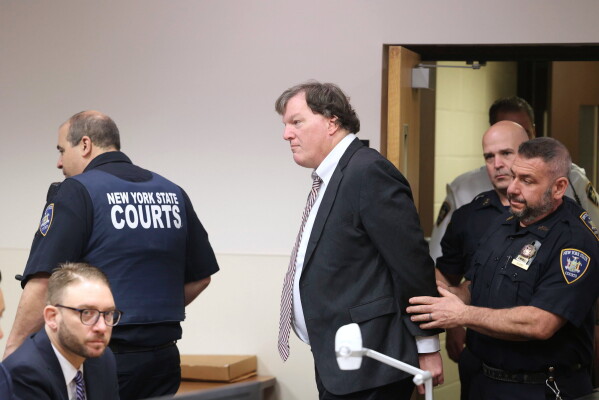
After years of waiting for justice, family members of the victims killed by New York’s Gilgo Beach serial killer spoke out during the sentencing of Rex Heuermann, who acknowledged his responsibility for the murders. “The words I would say would have no meaning,” admitted Heuermann, the Long Island architect who had secretly killed eight women over the years. The investigation, which brought closure to one of the state’s complex mysteries, connected the disappearances of the women to Heuermann. It became a topic of true-crime documentaries, books, and podcasts after police found victims’ remains along a coastal parkway.
Heuermann, 62, received a life sentence with no chance of parole. “A million years isn’t enough,” said Jasmine Robinson, a cousin of victim Jessica Taylor. “Nothing will ever make this right.” Robinson expressed her disdain, unable to contain her disgust towards Heuermann. While family members of the victims spoke, Heuermann sat quietly, looking ahead and occasionally tapping his fingers. Amanda Funderburg, sister of Melissa Barthelemy, urged him to face her while recounting a distressing call he made to her after her sister’s disappearance when she was 15 years old. “I hope you suffer,” she stated.
JoAnn Mack, mother of Valerie Mack, confronted Heuermann, highlighting the impact of losing her daughter and her dreams. Despite justice being served, she lamented that it could not replace what had been taken from them. Heuermann confessed in April to killing seven women: Barthelemy, Mack, Taylor, Megan Waterman, Amber Lynn Costello, Maureen Brainard-Barnes, and Sandra Costilla. He also admitted to murdering Karen Vergata, though charges were never filed for her death.
During sentencing, Judge Timothy Mazzei showed disbelief at Heuermann’s crimes, questioning if he felt any remorse. Heuermann nodded slightly. “You are disgusting—a despicable man,” the judge declared. As Heuermann was escorted from the courtroom, the audience showed their disdain.
Victims’ family members recounted their losses, stressing the void left by the murders. Liliana Waterman, who was three when her mother disappeared, said she had waited her whole life to confront the killer. “She can finally rest in peace,” she mentioned. The majority of the victims vanished between 2000 and 2010, and their remains were uncovered on Long Island, primarily near Gilgo Beach. Costilla’s remains were found in 1993 while Vergata’s were discovered in 1996. Brainard-Barnes’ children, who were young when she vanished, emphasized how her absence affected them. Her sister, Melissa Cann, expressed long-held guilt over not protecting her more, but acknowledged that blame lies with Heuermann alone.
Heuermann’s capture marked a significant breakthrough in the case, initially surfacing in 2010 when remains were discovered amid a separate investigation concerning Shannan Gilbert’s disappearance. Arrests stalled until 2022 when evidence linked Heuermann to a truck spotted in 2010. Authorities matched DNA from a discarded pizza crust to hair found on victims. Additionally, digital evidence, including a “blueprint” for murders, bolstered the case against him.
Heuermann will transfer to state prison, following three years in a solitary segregated cell where he spent time reading crime novels. Called a “monster” by Suffolk County District Attorney Ray Tierney, the consensus at his sentencing was clear: no expression of remorse could lessen his crimes’ severity.
Defense attorney Michael Brown suggested Heuermann might have shown sincere remorse, pointing to emotional moments during their interactions. Nevertheless, the heinous nature of Heuermann’s actions overshadowed any perception of normalcy. As part of his plea agreement, Heuermann will assist the FBI’s behavioral analysis unit in tracking other serial killers.