
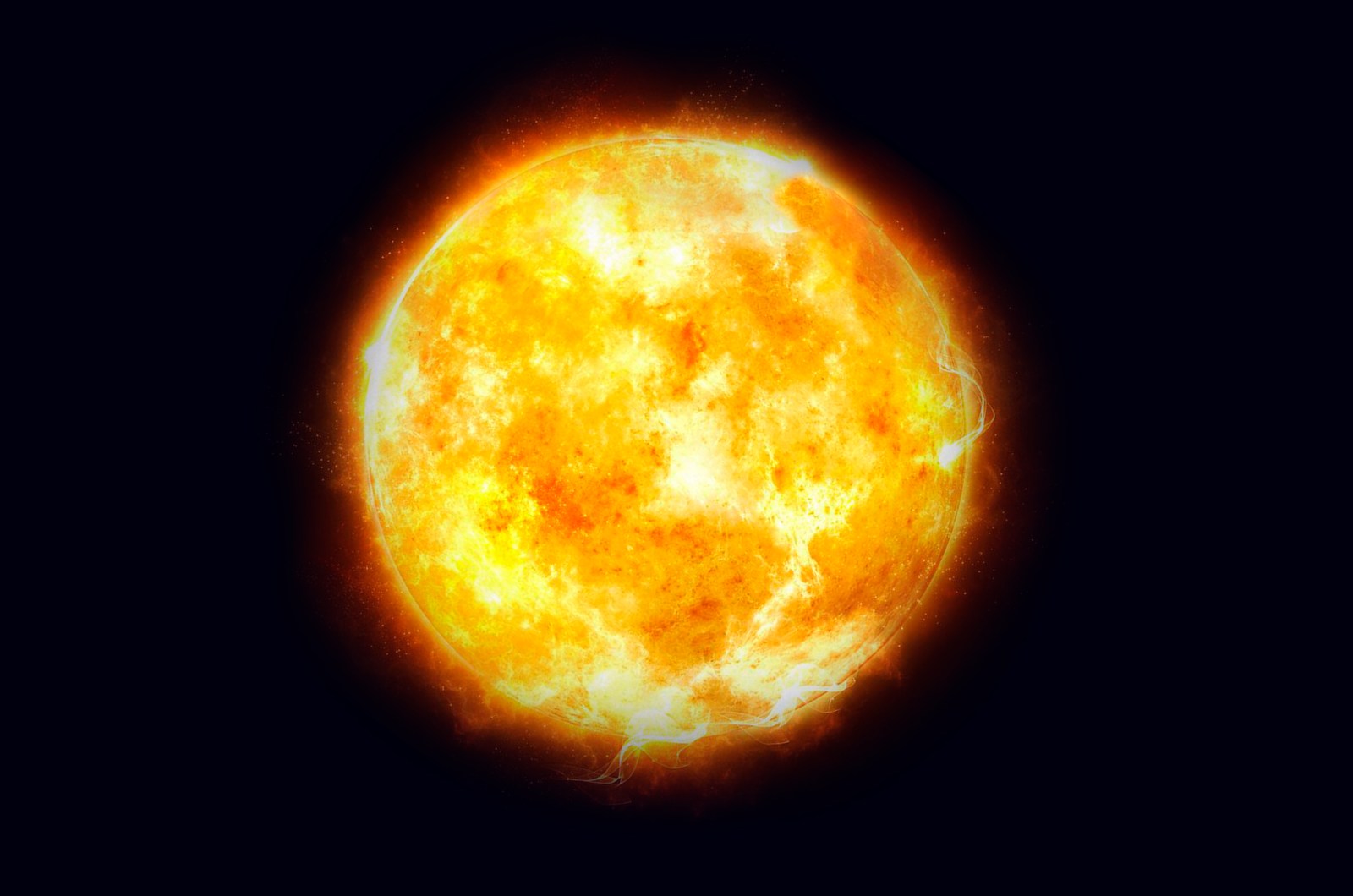
A giant planet has surprisingly survived the violent end of its sun, challenging predictions about the future of our own solar system. It is a scientific fact that our sun will eventually deplete its fuel. As it enters the red giant phase in a few billion years, the sun will expand and potential engulf nearby planets.
During this phase, the sun will enlarge, melting and evaporating the inner rocky planets. Experts, including NASA, anticipate that Mercury and Venus will be consumed. What exactly happens to Earth and other planets when the sun reaches this phase has been a subject of study and debate. Recently, astronomers discovered a giant planet, WD 1856b, that somehow endured the demise of its sun.
Ryan J. MacDonald from the University of St Andrews explained to Newsweek that planets around the sun will move further away when the sun dies, due to the resulting white dwarf having less mass. However, WD 1856b moved closer to the white dwarf, a change likely caused by the gravitational pull of two nearby red dwarf stars.
Identified in 2020, astronomers spotted a giant planet orbiting a white dwarf and questioned its survival through the sun’s red giant phase. The study, using data from NASA’s James Webb Space Telescope (JWST), analyzed the planet’s atmosphere and reconstructed its movement history.
For the first time, JWST observations detected methane and high-altitude hazes or aerosols within the planet’s atmosphere. This breakthrough allowed astronomers to characterize the atmosphere of a planet surrounding a dead star, revealing the composition of a world orbiting a white dwarf. These findings highlight that planets in residual stellar systems can maintain detectable atmospheres, offering new opportunities to study the evolution and potential habitability of planetary systems post-stellar death.
Originally, the planet orbited at a safe range and migrated toward the star billions of years after its demise. Christopher O’Connor from Northwestern’s Center for Interdisciplinary Exploration and Research in Astrophysics stated that these findings influence the long-term fate of our solar system.
O’Connor mentioned, “In roughly five billion years, our sun will die, and we don’t know precisely what will happen to the planets at that time. The fact that planets can survive into that final stage of the stellar life cycle really widens the range of possibilities for where and when habitable planets might exist in the universe.”
WD 1856b is a gas giant similar to Jupiter’s size, orbiting a star as small as Earth and situated around 80 light-years away. Sunlike stars that collapse become dense remnants called white dwarfs. O’Connor described this planetary system as “one of the most bizarre” due to the planet’s size and orbital proximity, completing a revolution every 1.4 days.
The planet should have perished during the star’s red giant phase, during which a sunlike star expands to over 100 times its size. Two theories explain the planet’s survival: It either endured ingestion by the dying star and emerged intact or shifted position due to gravitational pulls from other objects.
In a triple star system, outer companion stars might have affected WD 1856b’s path. Researchers explored these theories using NASA’s telescope and observed the planet’s higher-than-anticipated temperature, even factoring in the white dwarf’s light. They concluded that the planet heated as it approached the star, occurring up to 5.5 billion years after the star transitioned to a white dwarf, allowing safe distance during its destructive phase.
MacDonald expressed that giant planets in our solar system might replicate such migrations, inching closer to the white dwarf left post-sun death. This shift might be triggered by gravitational interactions among giant planets or a distant star’s influence.
According to MacDonald, this planet and star provide a preview of possible scenarios when our sun eventually perishes. He highlighted, “It’s the first time we have been able to look forward to what might happen to the outer planets around the remnant of a sunlike star.” He referred to it as using “a time machine to peer into the distant future of our solar system.”
“Our results show that stellar death is not the end—some planets experience a vibrant and lively future after the death of their star,” MacDonald said.
Reference: MacDonald, R.J., O’Connor, C.E., Boehm, V.A. et al. Aerosols and hydrocarbons in the atmosphere of a white dwarf planet. Nature 655, 76–80 (2026). https://doi.org/10.1038/s41586-026-10514-7
Contact Newsweek editors on this story: Kara Dolman and James Debens.