
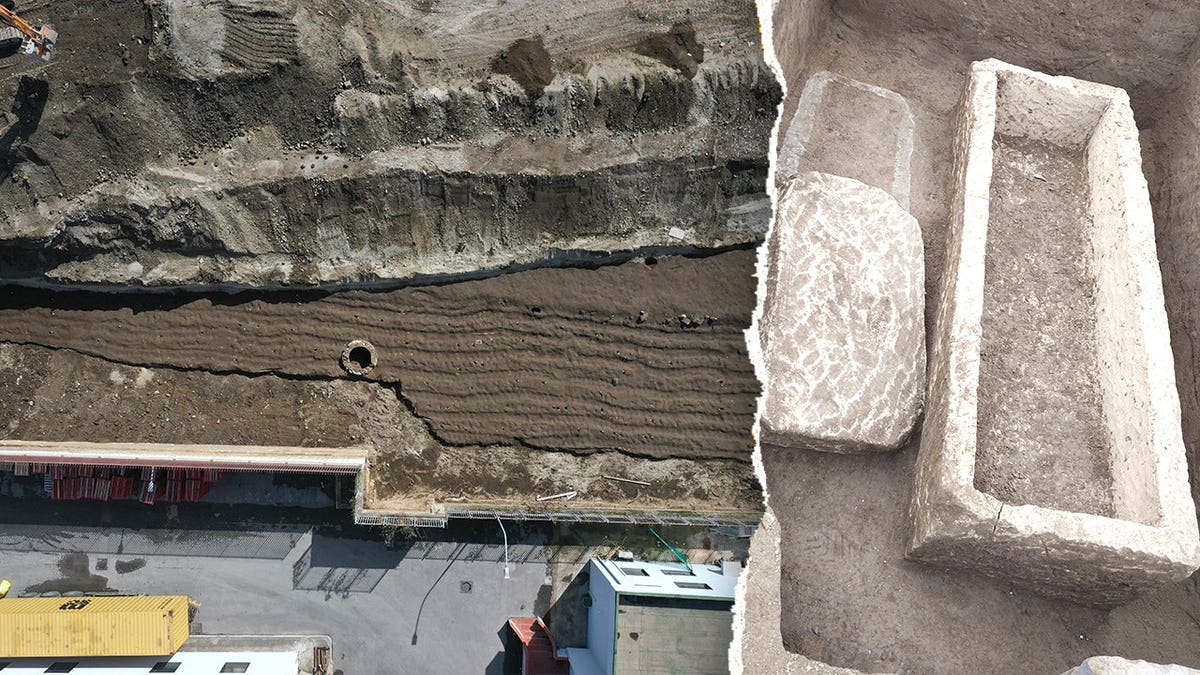
A surprising discovery emerged during an expansion at the Pasta Garofalo factory in Gragnano, Italy. Archaeologists uncovered a 2,600-year-old necropolis while the factory was preparing to increase its production capacity. This town, located near Naples, now boasts an ancient city of the dead filled with tombs and rare artifacts.
The archaeological work was conducted between 2025 and 2026. It revealed the site dating back to the first half of the sixth century B.C., a period known as the Archaic period in Mediterranean history. This predates the Roman Empire by several centuries.
Images from the excavation showcase rows of stone burial chambers containing human remains, pottery, and various other artifacts. Some chambers preserved rare materials such as textiles, wooden objects, and woven baskets. Officials highlighted these findings as crucial for enhancing our understanding of funerary practices, social organization, and daily life during that era.
Executives from Pasta Garofalo found great significance in their discovery. The site revealed important grave goods including Egyptian scarabs, amber ornaments shaped like animals, and silver and bronze items of Etruscan origin. These items demonstrate Gragnano’s historical position within Mediterranean trade networks, connecting Greek, Egyptian, and Etruscan cultures.
“These exceptional finds testify to the central role played by the ancient territory of Gragnano within Mediterranean trade networks,” stated Pasta Garofalo.
CEO Massimo Menna expressed pride in this discovery, citing Gragnano’s historical importance and its longstanding ties to pasta-making. Menna emphasized the company’s commitment to preserving and enhancing local heritage.
Researchers aim to study the osteological remains further. Their goal is to uncover insights into the ancient community’s diet, mobility, and living conditions.
This discovery follows other significant findings in Italy, including the recent unearthing of an ancient sanctuary in northern Italy. Trento also revealed a nearly 3,000-year-old necropolis dating back to the Iron Age.