
On July 6, 1776, John Hancock, president of the Continental Congress in Philadelphia, dispatched a letter to General George Washington. At the time, Washington was with his troops in New York. The letter included copies of the newly adopted Declaration of Independence.
Asher Lockner, a 14-year-old from Brooklyn, captured an image of the Declaration of Independence at the National Archives. Hancock elaborated that Congress had been occupied by a vital and monumental matter. This matter culminated in a declaration of independence from Britain, a step Hancock described as a duty owed to both themselves and future generations. He requested Washington to announce the declaration to the troops in a manner he deemed appropriate.
The subsequent actions further cemented Washington’s role in the nation’s founding and established his ongoing recognition. Photographer Matt McClain documented these significant moments leading up to the nation’s 250th anniversary. His work reveals the enduring presence of George Washington as a unifying figure amidst contemporary divisions in America. Doug Thomas, portraying Washington, participated in Revolutionary War Weekend at Mount Vernon, the former home of the first president in Virginia, this past May.
On July 9, Washington, then 44, instructed thousands of Continental Army soldiers to gather on Manhattan’s parade grounds at 6 p.m. to listen as the declaration was read aloud. According to a general order, Washington expressed hope that this crucial event would motivate every officer and soldier, recognizing that the country’s peace and security depended solely on the success of their efforts.
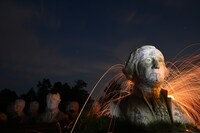
A representation of the famous painting, “Surrender of Lord Cornwallis,” located in the U.S. Capitol Rotunda, shows the British surrender to Washington in Yorktown, Virginia, in 1781, marking the last significant battle of the war. Scenes of a re-enactor near an image of Washington in Alexandria and Washington-themed merchandise in a Mount Vernon shop show his enduring cultural impact. During January, Washington’s image was projected on his 555-foot monument as part of the nation’s celebration events.
The reading of the declaration created excitement, according to Doug Bradburn, president and CEO of George Washington’s Mount Vernon. Historian Emily Sneff noted that Hancock likely sent a stack of printed declarations to Washington through a courier. Doug Thomas often portrays Washington at military demonstrations at Mount Vernon. Samuel Blachley Webb, an aide-de-camp to Washington, recorded in his journal that the troops responded to the reading with enthusiastic cheers.
The following day, Washington conveyed to Hancock that the troops warmly received the declaration. Yet, the Americans faced a looming threat from a British force, which had dispatched more than 40 warships and 30,000 soldiers and sailors to New York.
Reenactors like John Williams from Haddonfield, New Jersey, and others portraying the 1st Virginia Continental Artillery Regiment, lend authenticity to events at Mount Vernon. Scenes of everyday life, like Joe Whitney dining with his Jack Russell terriers during a reenactment, provide insight into historical events.
Reflections from Colonial Williamsburg reveal the historical context of Washington’s visits, including his time in the Virginia House of Burgesses, a legislative assembly with county representatives. Sneff emphasized that Washington’s receipt of the Declaration of Independence in 1776 was pivotal. While the Continental Congress articulated independence in writing, Washington was charged with the formidable task of winning the war and securing freedom. The effort to bring the declaration to fruition continued until Washington’s subsequent triumph at Yorktown in 1781.
A lone bird over Surrender Field at the Yorktown Battlefield, where Washington and French allies achieved a decisive victory, marks the turning point in the quest for American independence. New exhibits at the American Revolution Museum at Yorktown detail these moments in history, with rebuilt period sites adding visual context.
In July 1776, Bradburn noted, Washington could not have foreseen his elevation to leadership or the dedication of cities and monuments in his honor. Prominent reminders of his life, like the conservation of his Mount Vernon estate, the celebration of his birthday, and even the preservation of his dentures, contribute to his historical significance.
Displays at Mount Vernon feature Washington’s dentures, and glimpses of his family’s coat of arms at the George Washington Birthplace National Monument in Virginia offer deeper historical insights. Images from George Washington’s Office Museum in Winchester recall his participation in the French and Indian War. Collectively, these artifacts and reenactments reflect the life and times of Washington, inviting modern audiences to explore his enduring influence.