
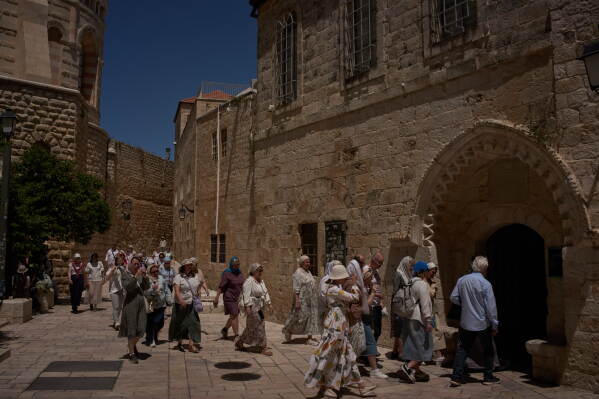
Support for Israel significantly influences the religious identity of many Jewish adults over 45 in the United States. However, younger Jewish adults tend to prioritize other connections, such as celebrating Jewish holidays. A recent AP-NORC poll highlights that the generational divide concerning Israel’s actions, particularly after the Hamas-led October 2023 attack, extends into religious identity.
I pray for people in the land of Israel. I don’t need to pray for the state,
said Cameron Bernstein, 27, a medical student in New Orleans. Despite having celebrated her bat mitzvah in Israel, Bernstein states that Israel doesn’t play a role in my life, more than another country with people I love.
The survey from The Associated Press-NORC Center for Public Affairs Research, involving 1,022 Jewish adults, reveals this division in support for Israel is notable among those identifying as religiously Jewish. Jewish adults unaffiliated with religion but identifying ethnically or culturally as Jewish generally possess less emotional connection to Israel.
Survey Methodology
The Associated Press-NORC Center conducted the survey with 3,040 U.S. adults from June 11-17, 2026, part of NORC’s AmeriSpeak Panel, representative of the U.S. population. It included 1,022 Jewish adults, providing reliable estimates of their opinions. Survey weighting adjusted the results to accurately reflect population proportions.
Respondents were considered Jewish if they declared their religion as Jewish, or identified as Jewish due to ethnic, cultural, or familial reasons. Among religiously Jewish adults, comprising 68% of the total Jewish populace, around 60% consider being Jewish extremely
or very
important. In older religious Jews, roughly half view supporting Israel as vital, similar to those celebrating Jewish holidays.
In contrast, about 40% of younger religious Jews emphasize Israeli support, while 70% prioritize Jewish holiday celebrations. Susan Boyer, 72, from Southern California, believes supporting Israel means securing a homeland for Jewish people. With increasing antisemitism concerns, Boyer views Israel as a defense against potential large-scale atrocities like the Holocaust.
I’ve been defending myself as a Jew since I was a child… It’s invasive into your daily living that you have to constantly, constantly be defending yourself as a Jew,Boyer expressed.
Younger Generation’s Perspective
Ari Pollack, 30, an arts fundraiser in Wisconsin, criticizes Israel’s military operations, claiming they fuel antisemitism and endanger Jews globally. I’m personally pretty opposed to basically everything Israel’s doing these days,
Pollack noted, recounting the pro-Israel ideology ingrained in religious schooling.
Similar to 30% of religious Jewish adults under 45, Pollack accuses Israel of committing genocide during the Gaza war, a claim denied by Israel. This sentiment differs from the 20% of Jewish adults over 45 who share the view.
Other Jewish cultural aspects remain crucial to many younger adults. Compared to older Jewish counterparts, those under 45 are likelier to stress the importance of Shabbat observance and dietary restrictions in their Jewish identity.
Phoebe Wapnitsky, 32, from Connecticut, opposes Israel’s military actions for misaligning with her perception of Jewish values. Standing against oppression, promoting social justice — those are the roles that Judaism plays in my life,
she said, feeling detached from Israel even before the recent attack.
Attorney Brian Ebarb, 47, of Louisiana, emphasizes his Jewish identity on action and community
, which he believes include supporting Israel. He insists on critiquing government mistakes without generalizing or harming global Jewish people. The existence of the state of Israel is so precarious that we have to be careful to avoid letting criticism of Israel become criticism of Jews worldwide,
says Ebarb.
This content is part of Associated Press religion coverage, supported by an AP collaboration with The Conversation US, funded by Lilly Endowment Inc. The AP bears sole responsibility for this content.
Conducted by the AP-NORC Center, the survey involved 3,040 adults with interviews including 1,022 Jewish participants. The sampling error margin for all adults stands at 2.8 percentage points, while it is 5 percentage points for Jewish adults.