
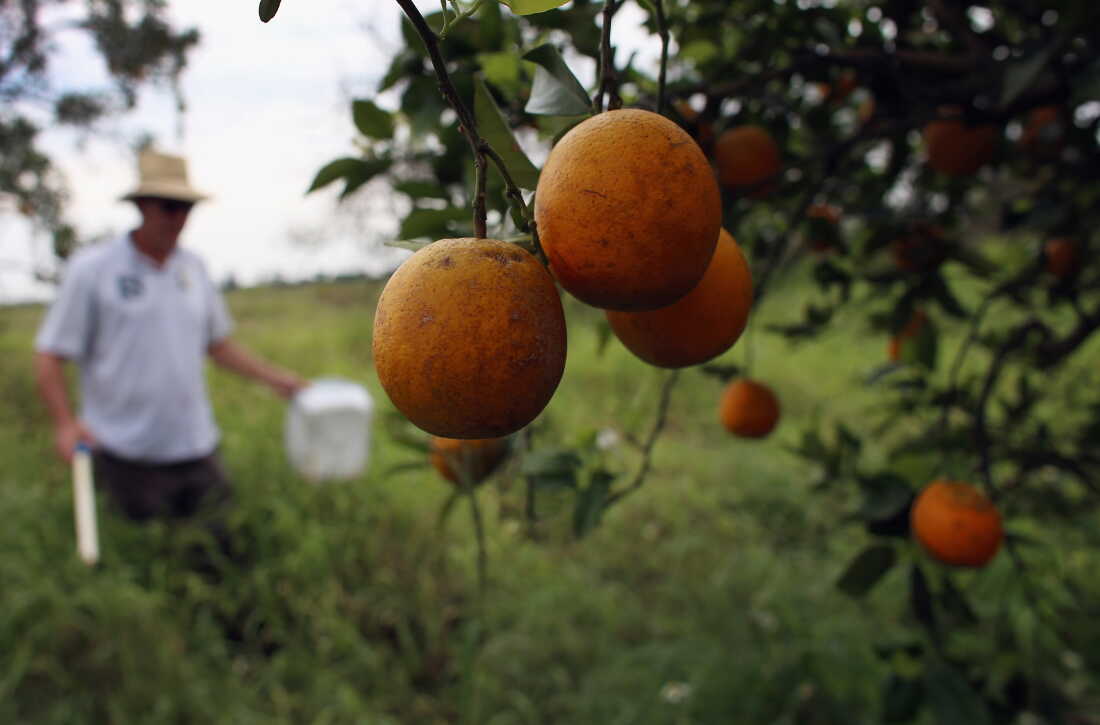
In Florida, citrus growers are planting new trees modified through gene-editing technology to resist the destructive citrus greening disease. This condition, caused by a bacterium spread by the Asian citrus psyllid insect, has devastated many citrus trees in the state. Traditional methods such as protective tents and sprays have failed to halt the infection’s spread, leading to a significant decline in Florida’s citrus production.
The disease first appeared in the state in 2005. It severely compromises the trees’ immune systems, leading to bitter and discolored fruit that eventually kills the tree. Despite intense efforts, growers have found no cure for citrus greening. Growers, like Ron English from Valrico, Florida, witnessed their family businesses crumble due to the disease, compelled to cease operations by 2015.
Before the arrival of citrus greening, Florida shipped around 300 million boxes of fruit each season in the late 1990s, according to Matt Joyner, CEO of Florida Citrus Mutual. In stark contrast, the latest season saw shipments reduced to a mere 15 million boxes. To counter the threat, Soilcea, a company based in Tampa, has utilized CRISPR gene-editing technology to develop a rootstock named CarriCea T1, which promises resistance against citrus greening.
“The key lies in focusing on the rootstock,” stated Yianni Lagos, CEO of Soilcea. “Symptoms like yellowing leaves appear only after the root system is half dead.”
This innovative rootstock supports the tree’s immune system, enabling growers to reduce insecticide usage. Lagos is closely monitoring trials where the CarriCea T1 rootstock is grafted onto trees. In test fields like those in Thonotosassa, Florida, Ron English has observed promising results with trees featuring this modified rootstock.
“You can see the CarriCea rootstock’s impact on the leaves,” English remarked, noting the stark difference between a modified tree and one without the CarriCea T1 rootstock.
The real test for CarriCea T1 trees will come when they start to bear fruit. This will reveal not only the growth but also the taste quality of the produce. Yianni Lagos acknowledges this uncertainty, explaining that “until you have a 10-year-old tree, you don’t know how the tree is going to perform.” As citrus growers await the results, hopes are pinned on this genetic advancement to transform the future of Florida’s citrus industry.