
During the Group of Seven summit in Evian-les-Bains, France, leaders expressed support for U.S. President Donald Trump’s tentative agreement with Iran. This agreement aims to open the Strait of Hormuz and extend a ceasefire. French President Emmanuel Macron described the agreement as a ‘very good deal,’ emphasizing its potential to halt instability impacting global economies.
At his press conference, Trump labeled the agreement as ‘historic.’ He noted that other G7 leaders expressed approval, wanting the situation resolved. U.S. officials provided details to journalists, noting official signing scheduled for Friday in Switzerland. The accord suggests removing U.S. and UN sanctions on Iran if Iran’s nuclear program concerns are addressed. Trump expressed optimism, stating, ‘They want to sign. They want to get back to a normal life.’
On the final day of discussions at the French Alps resort, Trump was notably the last to arrive among the assembled leaders. The formal dialogue addressed artificial intelligence, economic growth, and concerns over China’s market practices. Leaders from India, South Korea, Kenya, and Brazil participated.
Trump attended a dinner at the Palace of Versailles before returning to Washington. At the palace, he praised Macron and his wife, Brigitte.
The Importance of the Strait of Hormuz
The agreement’s outcome pivots on resuming traffic through the Strait of Hormuz, crucial for oil transport. Trump needs to convince dissenting Republican members who are skeptical about controlling Iran’s nuclear ambitions. The international community awaits fulfillment of Trump’s assurance that the strait will reliably reopen.
G7 leaders indicated a maritime mission by France and the U.K. could facilitate reopening the strait. This mission would involve protecting vessels and ensuring all mines are cleared. The strait has been closed since the conflict began on February 28.
Ceasefire and Lebanon’s Territorial Integrity
The deal includes ending hostilities in Lebanon between Israel and Hezbollah. This issue remains sensitive due to Israel’s stance on its self-defense and territorial claims. G7 leaders supported Lebanon’s efforts to disarm Hezbollah and uphold sovereignty, noting Israel’s strikes have severely impacted Lebanese civilians.
Global Security Commitments
G7 leaders reaffirmed support for Ukraine against Russia’s invasion, promising air defense systems and enhancing sanctions on Russia’s energy sector. Trump described discussions on Ukraine as ‘productive,’ indicating both leaders in Moscow and Kiev are looking for solutions.
The leaders also vowed to combat the global drug trade. Trump’s military operation targeting drug boats in Latin America has faced scrutiny about its legality due to over 200 fatalities since its inception.
In tackling migration challenges, the G7 reiterated efforts against migrant smuggling and trafficking, categorizing these as severe transnational crimes.
U.S.-India Relations
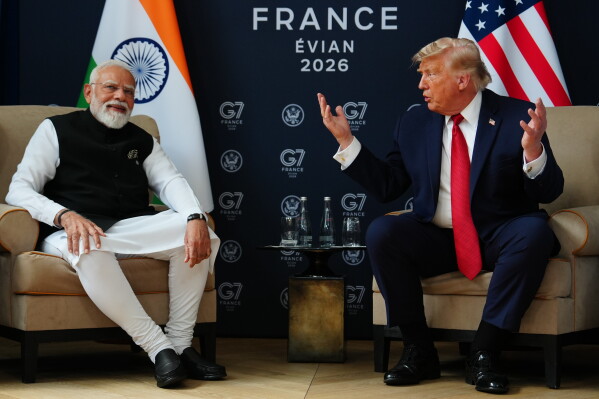
Trump praised Indian Prime Minister Narendra Modi after their meeting, describing the U.S. as nearing a trade agreement with India. However, tensions exist due to previous incidents in the Middle East, such as the death of Indian sailors during a U.S. strike in the Gulf of Oman. Modi emphasized the safety of India’s mariners as a priority.
Reporters from various locations contributed to this article, offering comprehensive coverage of the summit and related events.