
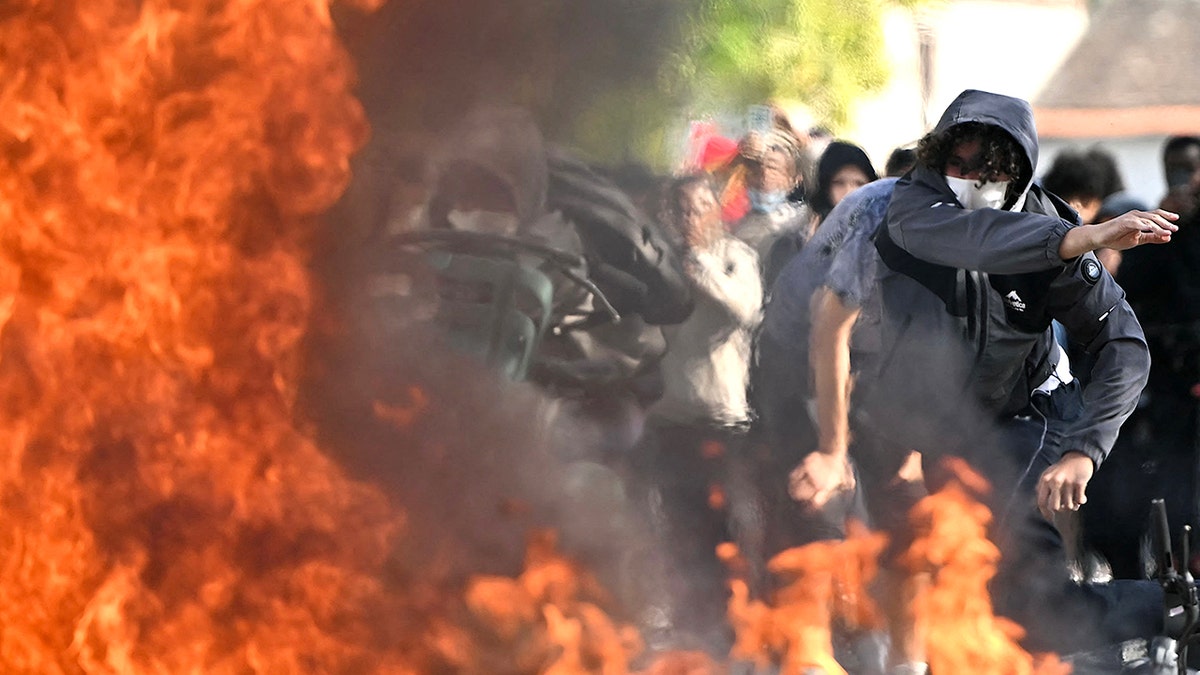
French student protests over deteriorating school conditions are escalating, driven by broader political and economic tensions. Despite billions in public spending, experts warn that France’s financial troubles, President Emmanuel Macron’s weakened political center, and radical movements are intensifying the unrest.
Roots of the Protests
What began in September with legitimate grievances about school infrastructure transformed into larger confrontations with the state, according to Simone Rodan-Benzaquen of the Foundation for Defense of Democracies. She highlights how political actors have exploited the situation. Despite the anger being genuine, she notes that organized violence doesn’t aid in educational reform.
Ineffective Spending
Although 72% of France’s educational budget supports salaries and pensions, only 8.5% is allocated to infrastructure improvements. This distribution, reflecting the entire education system, underscores the lack of investment in facilities and equipment.
Underlying Economic Strains
Harvey Feigenbaum from George Washington University attributes the crisis to France’s financial pressures. With a public debt of 117.6% of GDP, the country faces severe borrowing constraints that complicate responses to unrest. The political fragmentation further complicates efforts to address public dissatisfaction.
The Political Landscape
Macron’s centrist policies, meant to transcend traditional political divisions, have weakened moderate parties without forming a stable coalition. This political shift has opened space for polarized movements. Feigenbaum criticizes Macron’s pension reforms for failing to garner public support, sparking further protests.
Structural Challenges
The protests initiated in the Paris suburbs, citing class size and inadequate facilities. Years of ministerial changes and unreformed systems have fueled frustrations, as reported by Rodan-Benzaquen. The OECD noted France’s spending per student significantly surpasses the global average, yet basic shortages persist.
Emergency Measures
In response to the situation, Education Minister Édouard Geffray proposed deploying 3,000 trained educators at high-pressure schools, costing millions in euros. Student unions viewed this as an initial success but vowed to continue demonstrations.
Political Manipulation
The involvement of the hard-left La France Insoumise party reveals a complex political dimension. Concerns arise about how various groups exploit student frustration. Rodan-Benzaquen argues these movements aim to polarize the electorate ahead of the 2027 presidential election.
Controversies and Diverse Influences
Reports suggest Islamist groups and pro-Palestinian activists are exploiting the unrest. Rodan-Benzaquen emphasizes the diverse political affiliations involved, cautioning against reductive interpretations based solely on immigration or religion.
A Polarized Environment
According to Rodan-Benzaquen, the protests highlight a divided society with starkly contrasting political realities. Social media amplifies divisions, complicating dialogue and consensus.
Structural and Financial Challenges
Feigenbaum identifies key structural dangers: a government trapped by financial obligations without the consensus needed for reform. France spends heavily on public institutions but struggles to fulfill public expectations, exacerbating conflicts.
The protests testing France’s ability to reconcile costly promises with fiscal realities.
Veteran reporter Efrat (Effie) Lachter contributed insights, drawing from her extensive experience covering global conflicts and political events.