
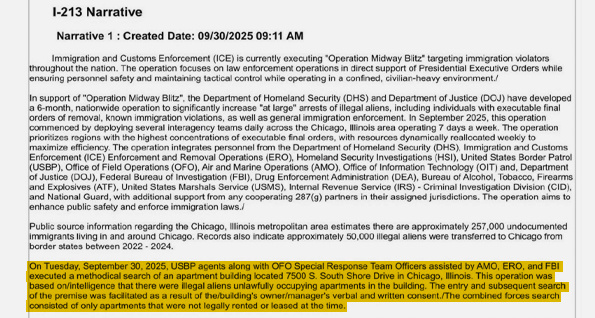
The Trump administration conducted a midnight raid on a Chicago apartment complex, claiming the presence of the Venezuelan gang, Tren de Aragua, in the building. However, new documents suggest something different. They reveal that the raid was related to allegations of immigrants squatting in the complex, with the landlord permitting federal officials to search the premises.
During the aggressive operation, agents from a Blackhawk helicopter detained 37 immigrants. New arrest records indicate that the landlord granted consent for the agents to enter, focusing on apartments that were not legally rented. This information contradicts the initial government narrative centered on gang activity. According to Mark Fleming from the National Immigrant Justice Center, the operation targeted supposed illegal occupants rather than gang members.
No mention of the Tren de Aragua gang appears in Homeland Security records. Though the government labeled some detainees as gang members, no proof has emerged. ProPublica’s investigations show little evidence to support the gang-related claims. Four months later, no criminal charges have been filed. ProPublica interviewed 15 detainees who denied gang affiliation. While they acknowledged criminal activity, they were unaware of gang members in the area.
The two arrest records are part of federal litigation questioning if government actions during a deportation campaign violated a 2022 consent decree limiting warrantless arrests. The decree remains contested. Government attorneys have admitted that many immigrants detained may have been improperly arrested.
Immigrant rights attorneys argue that the government misrepresented immigrants as flight risks without basis. The Department of Homeland Security’s criteria for warrantless arrests, including alleged flight attempts, are disputed. Most immigrants held during the raid have been deported or abandoned legal challenges.
Real estate investor Trinity Flood and management firm Strength in Management have not commented on their roles. A Department of Homeland Security spokesperson reiterated the legality of the raid without providing new information. There were allegations that Flood used federal agents to remove squatting tenants after the building failed inspections.
A state investigation is underway into the use of federal agents to remove Black and Hispanic tenants from the complex. In a complaint, state officials accused building management of blaming Venezuelan tenants for safety and maintenance issues and using stereotypes to label them gang associates.
The raid resulted in management company workers disposing of tenants’ belongings. State officials await responses from the involved parties.
Several Venezuelan immigrants expressed their frustration with the building owner and manager’s alleged cooperation with authorities. They remarked on the sudden and drastic manner in which they were removed and deported. One individual, Johandry José Andrade Jiménez, shared the impact on his family, who are now struggling without him in Chicago.
The apartment complex housed African American and Venezuelan tenants, some of whom paid rent under unsafe conditions. Mismanagement was prevalent, as some tenants deceptively collected rent for themselves. Flood disclosed in court that significant funds were invested in building repairs, while evictions were pending. The deterioration continued post-raid.
Shortly after the raid, court proceedings resulted in a new management company taking over and residents being forced to vacate. This marks the ongoing struggle over control of the complex and its residents.