
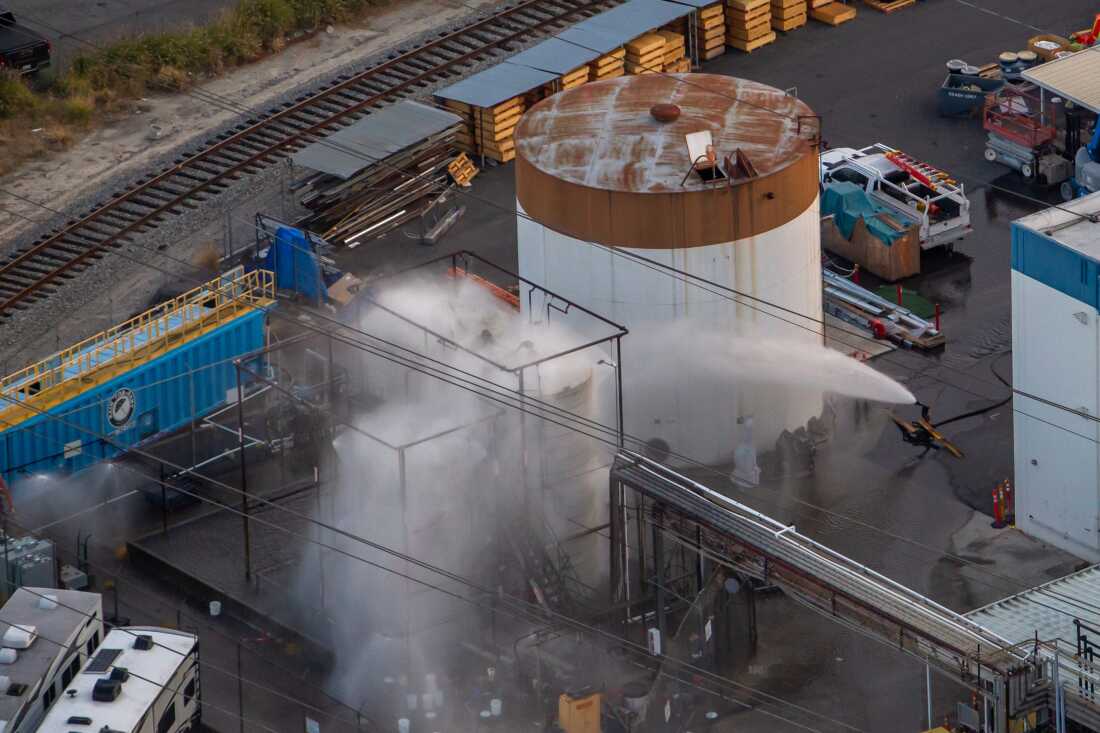
An aerial view captured the spraying of water onto a 34,000-gallon tank at GKN Aerospace on May 23, 2026, in Garden Grove, California. A malfunction at the aerospace plant poses threats of chemical leaks or explosions.
As of Sunday, approximately 50,000 residents in Garden Grove, California, remain under evacuation orders. This arises from an ongoing crisis at a nearby aerospace manufacturing plant.
Current Situation at the Aerospace Facility
Overnight, observations revealed a possible crack in the chemical tank. The tank, positioned in the southeastern area of GKN Aerospace, contains around 7,000 gallons of methyl methacrylate. This chemical is used in resins and plastics and is highly toxic and flammable. Late Saturday, interim county fire chief TJ McGovern of the Orange County Fire Authority shared updates via social media. He stated, “What they found was a potential crack in the tank.”
The incident began on Thursday and remains under investigation. Methyl methacrylate poses risks due to its volatile nature. It can release energy exothermically, increasing pressure inside containers. A similar incident occurred in the United Kingdom in October 2009, where an explosion caused significant damage and blew out windows 600 ft. from the site.
In California, the tank showed signs of damage, bulging outward, as noted by Craig Covey, the incident commander. Continuous water spraying aims to keep the tank cool. While two adjacent tanks remain stable, Covey suggested that a crack might be preferable. Slow leakage would reduce explosive threats, “In a weird world that’s the best-case scenario believe it or not,” he explained. This outcome would eliminate explosive hazards but still pose environmental risks.
Environmental and Health Concerns
GKN Aerospace reported ongoing efforts to contain potential leaks. Methyl methacrylate exposure can irritate skin and eyes and lead to respiratory and neurological issues. Long-term exposure risks include lung and organ damage.
Covey mentioned on Friday, “We’ve created containment barriers” in case of spills. Sand and other materials have been positioned to prevent chemical flow into waterways.
Evacuation Orders Remain
Residents are temporarily relocated to shelters following evacuation orders on May 22. This measure aims to protect against the dual threats of explosive blasts and toxic fumes. Orange County Fire Chief McGovern reassured residents via video statement, “We know that you’re out of your homes, we want to get you back, but we cannot do that until it’s deemed safe.”
The unpredictability of fume dispersal, though none detected yet, necessitates evacuations. The Environmental Protection Agency has set up monitoring stations to track potential fume emissions. McGovern noted, “The newfound crack could potentially be relieving some of the pressure in there.” He emphasized the progress as beneficial but cautioned that further developments are expected soon.