
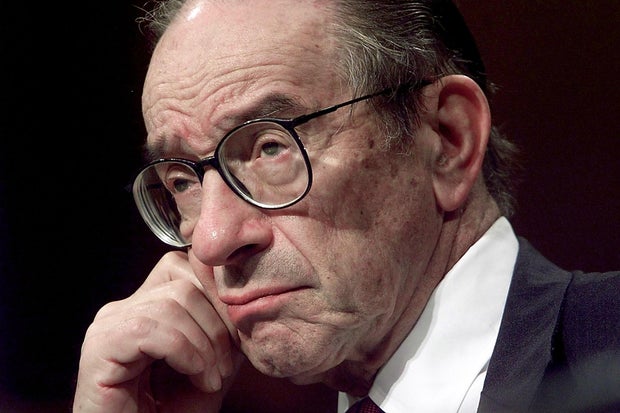
Alan Greenspan, an influential economist and former chairman of the Federal Reserve, passed away at the age of 100. His wife, Andrea Mitchell, announced his death, which occurred on Monday due to complications from Parkinson’s Disease. NBC News provided details of the statement.
Greenspan served as the Federal Reserve chairman under four U.S. presidents. During his tenure, he oversaw a period of economic stability known as the Great Moderation, lasting from the mid-1980s until 2007. This era was characterized by low inflation, stock market growth, and strong economic performance. However, his leadership was also marked by several financial crises, including the 1987 stock market crash and the early 2000s dot-com bubble burst.
In 1996, Greenspan coined the term “irrational exuberance” to describe investor behavior leading to market bubbles, particularly seen in the internet stock frenzy of that time. Despite his successful career, his legacy is often linked to the 2008 global financial crisis and the subsequent Great Recession. Critics suggest that his “loose money” policies contributed to the housing crisis that led to significant economic turmoil in the United States.
The Economist, in a 2017 piece, criticized Greenspan for his belief in market efficiency and inability to curb financial bubbles during his leadership. Greenspan defended his policies, arguing that history had been reinterpreted to criticize his actions unfairly. He claimed to have warned about the risky subprime mortgage market before the financial collapse.
Earlier, Greenspan admitted to Fortune Magazine that he underestimated the impact of human behavior on economics. He later acknowledged that human emotions, such as euphoria and distress, are consistent factors in economic forecasting.
Known for his cryptic economic insights, Greenspan urged for clearer Fed communications to minimize unnecessary market surprises. He believed in transparency from central bankers.
Born on March 6, 1926, in New York City, Greenspan showed early numerical talent and eventually pursued economics, earning multiple degrees from New York University. He was influenced by Ayn Rand and participated in her “objectivist salon.” His career began at the National Industrial Conference Board, and he later formed his consulting firm, Townsend-Greenspan & Co.
Greenspan held roles as chairman of the President’s Council of Economic Advisers and as a member of the Economic Policy Advisory Board under President Reagan. In 1987, President Reagan appointed him as the Fed chair, a position held through the administrations of George H.W. Bush, Bill Clinton, and George W. Bush. He retired in 2006 after years of significant influence on national economic policy.
In an interview with Fortune Magazine, Greenspan noted that while no president directly asked him to lower interest rates, some hinted at it, but none requested an increase during his time as Fed chair. Greenspan was married to journalist Andrea Mitchell since 1997.