
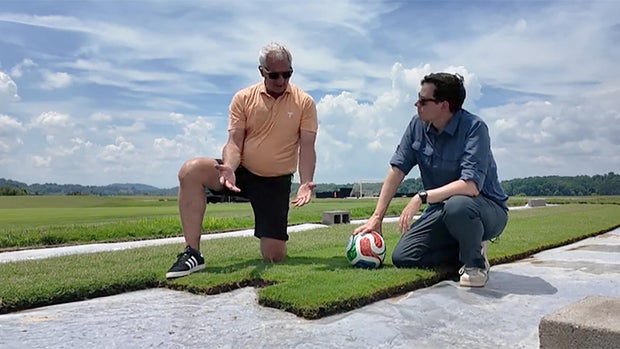
The current World Cup is breaking viewership records as Americans are more engaged with soccer than ever before. The final match between Spain and Argentina is expected to set a new record for viewership. For Dr. John Sorochan, a respected professor in Turfgrass Science at the University of Tennessee, Knoxville, the excitement is all about the quality of the fields.
Dr. Sorochan is a globally recognized expert in turf management. He emphasizes the importance of having a good playing surface for the athletes. Referring to the previous men’s World Cup, he notes that 1.8 billion viewers watched the final match without thinking about the field, yet much effort was put into preparing it.
The University of Tennessee has partnered with Michigan State University for the FIFA Pitch Research Project over the past five years. This year’s tournament, the largest in history, includes 104 matches across 16 stadiums in three countries. All matches must occur on natural grass, as mandated by FIFA.
Dr. Sorochan has played a crucial role in providing FIFA with the necessary natural grass. Different stadiums, ranging from varying elevations and climates, cannot all use the same grass type. Specialized sod, engineered scientifically, is transported from farms nationwide and laid over artificial fields. For instance, the grass for MetLife Stadium in New Jersey, where today’s final is held, was cultivated in North Carolina.
To accommodate the different needs, FIFA constructed an indoor facility in Tennessee for testing purposes. Here, grass is subjected to grow lights for 12-14 hours daily to ensure growth in domed stadiums. Sorochan explains that while a single match wouldn’t require this, maintaining the grass for weeks does.
Sorochan has developed a robot simulating a soccer cleat to test the grass’s durability. This machine mimics the force exerted by professional players. The goal is to ensure a consistent surface for World Cup matches. Testing also involves evaluating how a soccer ball interacts with the grass to manage its roll and bounce effectively.
Various grass types have been tested, including Meyer Zoysia and TifTuf Bermuda, popular in golf courses and sports fields. Brad Jean, the owner of Crossroads Sod Farm in Tennessee, frequently collaborates with the university’s experts when facing issues.
Jean emphasizes the benefits of natural grass over artificial turf. He states that artificial surfaces become extremely hot and can cause discomfort. Moreover, studies have associated artificial turf with higher injury rates, though newer types are somewhat safer.
Dr. Sorochan believes natural grass enhances the game’s playability and aesthetics. Grass contributes to the natural flow and beauty of soccer. Enzo Fernandez and Djed Spence recently showcased this during a semi-final match at Atlanta Stadium, playing on grass composed of Kentucky bluegrass and perennial ryegrass.
Following the tournament, FIFA offers fans the chance to purchase a piece of World Cup sod for $450. This allows enthusiasts to own a slice of soccer history.