
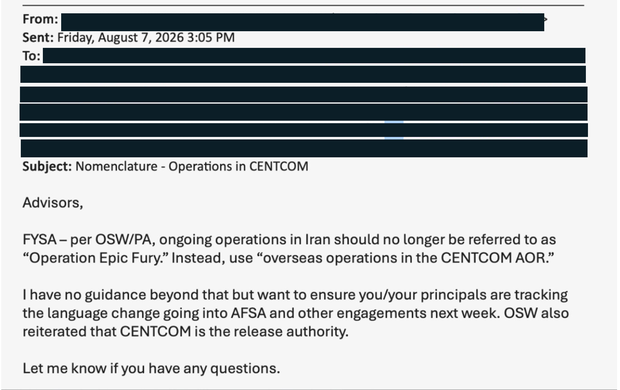
Washington — CBS News obtained an Air Force email from August detailing Pentagon instructions for personnel to cease using the name “Operation Epic Fury” for current U.S. military actions in Iran. This directive came three months after the Trump administration stated the operation’s conclusion.
The Pentagon confirmed the official end date of Operation Epic Fury as May 5, coinciding with Secretary of State Marco Rubio’s statement at the White House: “The operation is over.” Rubio informed Congress that the administration moved on to “Project Freedom.” President Trump had previously informed Congress that “hostilities” had “terminated,” but the Pentagon had been elusive about the operation’s formal end.
The May 5 date prompted questions on how the Pentagon classified service members killed or wounded post-Operation Epic Fury, and why updated guidance on naming ongoing operations emerged months later. An August email from high-level Air Force public affairs officers advised avoiding “Operation Epic Fury,” advocating broader terminology: “overseas operations in the [U.S. Central Command Area of Responsibility].”
Issued by Defense Secretary Pete Hegseth’s public affairs office, led by Sean Parnell, the guidance insisted on U.S. Central Command approval before releasing information on the Iran conflict. This directive, shared across the Defense Department, applied beyond the U.S. Air Force.
“Following the April ceasefire, … Operation Epic Fury had concluded on May 5,” a Defense Department official stated, detailing ongoing activities like Freedom of Navigation operations and strikes against IRGC threats.
Historically, the U.S. military records start and end dates for operations to clarify mission phases and military awards eligibility, providing Congress, service members, and the public with transparent tracking of involvement abroad.
Rubio was the sole Trump administration official to explicitly announce the operation’s conclusion. However, neither he nor Defense Secretary Hegseth provided a clear end date. Hegseth, in a separate briefing, distinguished Epic Fury from “Project Freedom,” a defensive maritime mission in the Strait of Hormuz, yet he didn’t confirm Epic Fury’s closure.
President Trump announced that “Project Freedom” would pause for U.S.-Iran negotiations, though its current status remains unclear. Hostilities resumed in July, following the breakdown of those talks.
Iranian forces and the U.S. continue sporadic exchanges, despite the Pentagon acknowledging May 5 as the operation’s end. This inconsistency prompted additional questions about the Pentagon’s August guidance instructing against using the Epic Fury name.
The May 5 date significant beyond the operation’s scope—offering clarity on military casualties incurred since conflict onset.
On July 18, casualties included 1st Lt. Tyler Feehan, Staff Sgt. Angel Rampersad, and Pfc. Isabella Gonzales, killed in an Iranian missile strike at Muwaffaq Salti Air Base, Jordan. A separate incident claimed the life of Staff Sgt. Michael Emmanuel Swinton in Iraq.
Initially classified under Epic Fury, these casualties were reassigned to “overseas operations” on July 25, reducing the fatality count attributed to Epic Fury hostilities. Pentagon spokesman Sean Parnell attributed these changes to “temporary data disruption.” Yet questions persist on the operation’s formal end.
The Pentagon’s Defense Casualty Analysis System still lists June injuries and July fatalities under Epic Fury, without displaying its official termination date.