
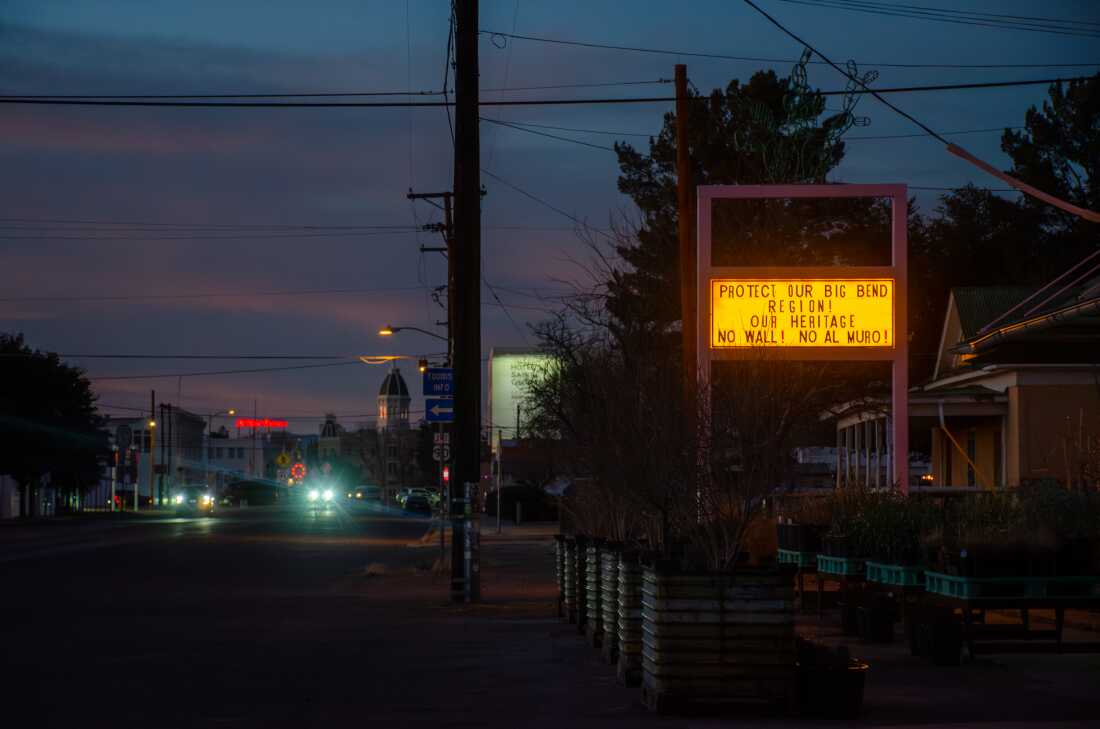
In the Big Bend region of Texas, signs opposing the construction of a border wall have appeared in homes and businesses, including a liquor store in Marfa. On a calm spring morning, Joe Pineda drives across his land by the Rio Grande, highlighting areas where he raises cattle and grows crops. The family cemetery, dating back to the late 1800s, also resides on the property. As he reaches the river’s edge, Joe, 52, slows his truck and reflects on his family’s deep history in this part of West Texas. He recalls his childhood spent here and the times with his own children. “It’s things like that that I’m going to miss,” Joe says, as wind moves through the overgrown vegetation by the river. “You enjoy moments with your kids and the heritage of your land where your ancestors lived, and now it might be taken away.”
Joe’s family received a letter from the federal government threatening eminent domain if they refuse to sell their land or allow access for wall construction. This scenario unfolds throughout the Big Bend, as the government plans to erect about 175 miles of border barrier. This untouched frontier country faces 30-foot steel fences, patrol roads, floodlighting, and surveillance systems.
Joe Pineda, sitting by the Rio Grande, uses the river’s water for alfalfa and pecan trees. However, he hesitates to run cattle this year due to worries about the wall. Uniting citizens across political lines, the community fears environmental and cultural harm. This area supports a $56 million tourism industry, now threatened, says Joe. “They’re harming our local economy with this wall,” he states. “Tourism brings significant revenue here. Everything is going to change, and it’s going to be sad.”
U.S. Customs and Border Protection assures NPR of efforts to minimize environmental impacts in planned construction areas.
A Gateway to Big Bend National Park
The region’s rugged landscape historically deters crossings into the U.S., with numbers declining since the start of President Trump’s second term. In early 2023, Customs and Border Protection’s Big Bend Sector recorded 498 apprehensions, just a fraction compared to Texas’ busiest sector. Brewster County Sheriff Ronny Dodson, with 26 years in law enforcement, acknowledges not being a primary crossing spot. “We support border security,” he says. “There are places for walls, no doubt, but not here. Monitoring and manpower should suffice.”
The county, large by land area, houses Big Bend National Park. Initially planned for a wall, CBP no longer plans tall fencing but will build vehicle barriers and patrol roads on the sensitive park land. Dodson and four fellow border sheriffs wrote to officials, stating that a wall in this area isn’t the most practical strategy. Their letters urge President Trump and Texas Gov. Greg Abbott to visit and understand the region personally.
A mile of border barrier in this part of Texas costs over $17 million. Hudspeth County Judge Joanna Mackenzie finds the expense staggering. “That kind of money changes generations,” she points out.
Opposition from All Sides
In a joint letter, Mackenzie and other top officials along the Texas-Mexico border requested a voice in border security decisions impacting their communities. “We’re told our opinions don’t matter, and we wonder what we can do,” Mackenzie says.
Some landowners in the Big Bend region are prepared to challenge the government through lawsuits to stop border expansion. A café in Terlingua displays a replica of the 30-foot steel wall. “This fight isn’t one we wanted,” says Raymond Skiles, a wildlife biologist and landowner. He displays a map from Customs and Border Protection outlining the proposed route through his land. “If this happens, it’ll scar the cherished landscape of the Big Bend,” says Skiles, visibly emotional. “It’s like slicing the Mona Lisa and leaving the cut for all to see.”
For Skiles and others, a wall through the Big Bend symbolizes a loss, marking an unwelcome memory of his home region.