
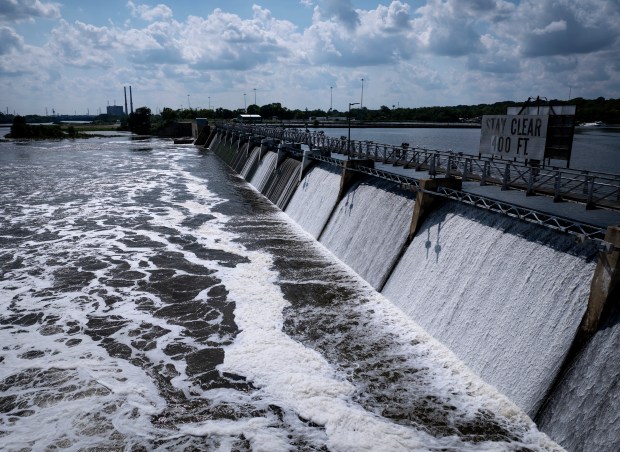
More than a month after halting work on the Brandon Road Lock and Dam near Joliet, the U.S. Army Corps of Engineers announced resumption of construction. This project, costing $1.15 billion, aims to prevent invasive carp from entering the Great Lakes. Advocates report the Army Corps issued a stop-work order on July 24 without explanation, stating the project was “under administrative review.” Shortly after, several hundred silver carp were found 80 miles from Lake Michigan in the Illinois River, suggesting potential spawning closer to the lake. This discovery signals a higher risk of invasion, according to advocates from the Alliance for the Great Lakes.
President Donald Trump had previously directed federal agencies to expedite the project on the Des Plaines River. The Army Corps did not comment on the halt. The Brandon Road Interbasin Project began construction in 2025, driven by cooperative efforts between Illinois, Michigan, and the federal government to block invasive fish threatening the Great Lakes’ ecosystem and economy. The project addresses unreliable barriers near Romeoville, now the last defense in the Illinois River.
Joel Brammeier, president and CEO of the Alliance for the Great Lakes, expressed concern over the delay, emphasizing the risk of irreversible harm posed by invasive carp. Regional support for the project spans congressional, state, environmental, and community sectors. Despite bipartisan backing, funding and project progression have faced political tensions, particularly between Trump and Illinois Gov. JB Pritzker and Michigan Gov. Gretchen Whitmer. The halt ended after discussions between Trump and Whitmer, with commitments to keep construction on track.
Late August saw Great Lakes environmental organizations from multiple states call for uninterrupted continuation of the project. Brian Gill of the Shedd Aquarium highlighted the damage non-native species inflict on ecosystems, advocating for proactive measures. Jennifer Walling, CEO of the Illinois Environmental Council, described the project as a vital bipartisan effort for waterways, communities, and the economy. Spencer Dirrig of the Ohio Environmental Council noted the apolitical nature of invasive carp, urging continued focus on blocking their entry into the Great Lakes.
Illinois and Michigan contribute $64 million and $50 million, respectively, to the project. In May 2024, increased federal cost sharing for operations and maintenance was secured, with 90% covered. Congress appropriated $274 million for phase one, involving site preparation, bedrock removal, and technology installations like bubble barriers and acoustic deterrents. Subsequent phases will add an electric barrier and more acoustic measures, along with a flushing lock to move fish larvae downstream.
Invasive carp species, including silver, bighead, grass, and black carp, emerged in the U.S. from aquaculture initiatives in the 1960s. Escapes due to flooding spread them across 31 states, disrupting local ecosystems. Silver and bighead carp, lacking natural predators, pose significant threats to native species. Contract fisherman Jim Dickau handles invasive carp for the Illinois Department of Natural Resources.
Monitoring crews discovered juvenile silver carp recently, prompting enhanced measures in upper river areas and tributaries using electrofishing to manage carp populations. Earlier surveys in Lake Calumet found none of the invasive species. Microchemistry studies of recent carp catches aim to trace origins.
Contract commercial fishing for adult invasive carp resumes in several pools with known adult carp presence. Biologists assess these areas lacking established multiple life stages of carp. Monitoring data over 16 years highlight established carp populations in lower Illinois River regions, affecting economies and ecosystems.