
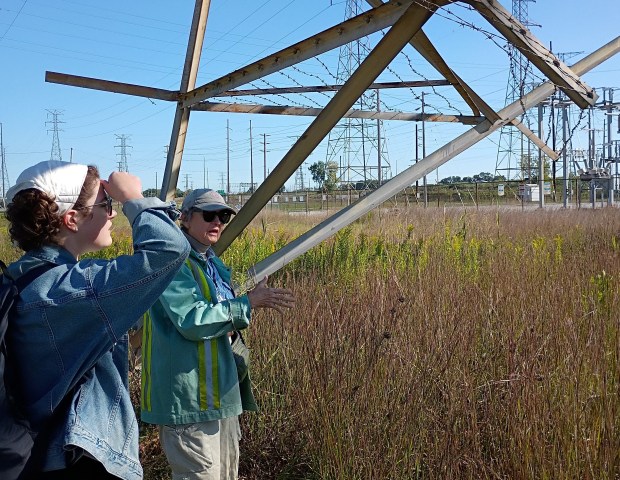
Tall transmission towers and high-voltage power lines stretch over the Eggers Grove Cook County Forest Preserve on Chicago’s Southeast Side, near 118th Street and the Illinois/Indiana border. On the ground, cyclists and hikers move past prairie plants and native grasses filled with early fall seeds—such as little blue stem, yellow prairie grass, goldenrod, whorled milkweed, purple coneflower, common milkweed, and coreopsis. Monarch butterflies flutter among these flowers during their annual migration south.
This landscape is one of 53 sites in northern Illinois where ComEd supports land management efforts benefiting monarchs. While many butterflies head to central Mexico, ComEd’s efforts are part of a larger trend of converting right-of-way (ROW) areas into supportive habitats.
Any space with a supportive pollinator habitat is crucial for species survival, whether it’s a pocket garden in someone’s backyard or a ROW.
These are the words of Catherine O’Reilly from the University of Illinois Chicago who coordinates Sustainable Landscapes at the Energy Resources Center. Six years ago, around 40 organizations formed the Nationwide Candidate Conservation Agreement with Assurances for Monarch Butterfly on Energy and Transportation Lands, or the Monarch CCAA. This agreement, which is valid through 2045, aims to support monarchs by encouraging landowners to adopt conservation practices.
O’Reilly notes that over 9.3 million acres are enrolled in this initiative, with more than 1.3 million acres designated as habitat. She regularly checks on ROW areas with volunteer stewards like Mary Kozlowski, who manage and preserve these sites.
In Illinois, where the monarch is the state insect, ROW commitments have led to milkweed resurgence. According to UIC’s report submitted to the Illinois Department of Natural Resources, milkweed stem counts rose by 108 million between 2014 and 2024, with half of these increases in ROW areas.
The Monarch CCAA leverages existing ROW practices like tree management, mandating specific conservation actions such as reducing mowing, planting natives, using targeted herbicides, brush and tree removal, and controlled burning and grazing. For native bumble bee habitats, the agreement also includes nest avoidance strategies.
ComEd, for instance, actively participates in these practices, including controlled burns under special permissions. These activities not only benefit pollinators but help utilities maintain operations when species become endangered.
When we sign an agreement, it helps us to help the monarchs, but it also allows us to continue with our operations if a species becomes endangered.
That’s from Sara Race, ComEd’s senior manager of Environmental Management. Additionally, ComEd partners with volunteers like Marianne Kozlowski who engage communities through habitat management activities. Kozlowski notes ComEd assists with clearing invasive species like buckthorn, highlighting a productive partnership.
Education programs also feature in ComEd’s strategy. Mighty Acorns engages young students in planting milkweed and eradicating non-native plants within ROW areas.
In 2020, the Illinois Department of Transportation (IDOT) pledged 401,000 acres of ROW to support monarchs. These areas see less frequent mowing, targeted herbicide use, and planting of native species. South of Champaign along I-57, IDOT removed invasive shrubs, planting native flora instead.
James Schackmann, IDOT’s resource specialist, emphasizes roadside maintenance’s dual focus—safe travel for motorists and promoting native species. Though some mowing is necessary, IDOT preserves 5,300 acres of native prairie, helping both the monarchs and infrastructure.
Non-native plants pose risks like clogged drains, which Schackmann explains can be costly in gas and labor. Reduced mowing also cuts safety risks from heavy equipment on ditches.
By maintaining a modern prairie, both IDOT and conservation groups ensure ecological functions like runoff absorption and carbon sequestration persist while pleasing motorists.
Susan DeGrane reports for the Daily Southtown.