
Industry Expertise
Evan Dent is an expert in vacuums and floor care at Wirecutter. He has evaluated various models in the robot vacuum sector. Sabine Heinlein has over two decades of journalism experience, focusing on home cleaning challenges.
Extensive Testing
Since 2012, we’ve tested dozens of robot vacuums, including 21 models between 2023 and 2025. Our testing involved over 80 hours of detailed examination in both controlled settings in Long Island City, New York, and various home environments with multiple pets and surfaces.
We have engaged in conversations with manufacturers, including companies like iRobot, Roborock, and Ecovacs. Additionally, we collected insights from robot vacuum owners and analyzed numerous customer reviews to identify important themes.
In line with Wirecutter standards, we either return or donate the products after completing our assessments. These assessments might include extended testing by us or our colleagues. We do not keep products as freebies after testing.
Who Benefits from Robot Vacuums
Anyone wanting clean floors may find value in a robot vacuum. These devices are particularly helpful for people short on time, those with mobility or dexterity constraints, or individuals who dislike vacuuming. They clean consistently without procrastination or boredom.
Pet owners and parents often appreciate the cleaner floors provided by robot vacuums. However, these machines offer a fraction of the suction power compared to standard upright or canister vacuums, making them more suitable as secondary cleaning options.
They excel at surface cleaning but struggle with dirt deep within carpets and near baseboards. Obstacle avoidance has improved, but users should still remove cords, toys, and socks before cleaning.
Evaluation Criteria
Cleaning Performance: Each robot vacuum underwent at least three cleaning cycles in various environments. We used a mix of rice, cat litter, and Cheerios spread across different areas, including spaces with furniture and rugs. We measured how much debris was collected by weighing the dustbin before and after cleaning cycles.
We also tested the vacuums’ effectiveness with pet fur and strands of hay, using baking soda alongside baseboards to assess debris collection. We evaluated the functionality of self-emptying docks.
Most robot vacuums now come with optional mopping functions. Machines were evaluated for this feature, though it’s not mandatory for use. Combined mop-vacuum models were tested and recommendations made cautiously due to issues with docks and mopping efficiency.
Obstacle Navigation: We assessed the robots’ ability to navigate over obstacles, such as door thresholds, and noted any frequent failure messages.
App and Voice Controls: User-friendly apps and voice assistant compatibility were considered, checking if features were functional and beneficial.
Repairability and Reliability: Durability was assessed through long-term use across different households. We monitored customer reviews and checked the availability of replacement parts.
Top Pick: Roborock Q7 M5+
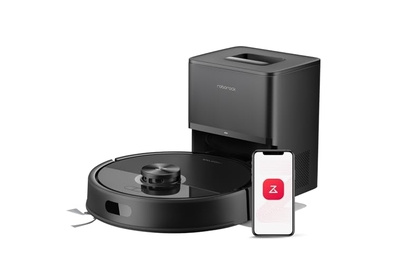
Roborock Q7 M5+ is an excellent cleaner with strong suction power and efficient navigation. It comes with a compact self-emptying dock, making it a thorough and quiet cleaner. Its app allows customizable cleaning settings.
The model features a self-emptying dock, compact and efficient for daily cleanings. The vacuum performs well in cleaning a variety of debris, including Cheerios and birdseeds, even near obstacles like barstools.
The vacuum capable of handling day-to-day cleaning comes with a mopping option, although basic. It has a long-lasting battery, running approximately 180 minutes under ideal conditions.
With strong cleaning power and smart features, the Roborock Q7 M5+ offers valuable benefits, despite having one side brush which may limit its ability to pick up debris near walls.
Runner-Up: Tapo RV30 Max Plus
Tapo RV30 Max Plus is a cost-effective machine with strong cleaning capabilities. While not as polished as the Roborock, it offers reasonable pricing and comes with a self-emptying dock.
With lidar navigation, this model quickly maps and cleans spaces efficiently, though it slightly lags behind in overall performance compared to our top pick. It offers a mopping feature, but it’s not necessary for operation.
The app works well, providing adequate customization, mostly comparable to our top pick. Replacement parts are available but offered in packages rather than individually.
Alternate Options
The Eufy L60 excels in managing hair and fur. It’s a good choice if the model is available for under $300. The Eufy RoboVac 11S Max offers basic functionality without modern app features but cleans well within its price range.
Models and Brands Evaluation
Several brands were tested, but not all met the standards necessary for a recommendation. iRobot Roomba vacuums, once a staple in households, encountered difficulties leading to the company’s bankruptcy in December 2025. Limited performance and customer service issues have been noted.
Care and Maintenance
Proper maintenance enhances a robot vacuum’s lifespan. Remove obstacles before cleaning sessions, such as cables and lightweight rugs. Regular upkeep involves cleaning filters, removing hair from brushes, and ensuring the sensors remain free of dust.
Replacement parts should be checked and replaced periodically, including filters, brush rolls, and batteries if necessary.
Anticipated Updates
Projects are underway to evaluate the Roborock Q10 X5+, which promises advanced navigation, and another model, the dockless 3i G10+, which avoids dust bags.