
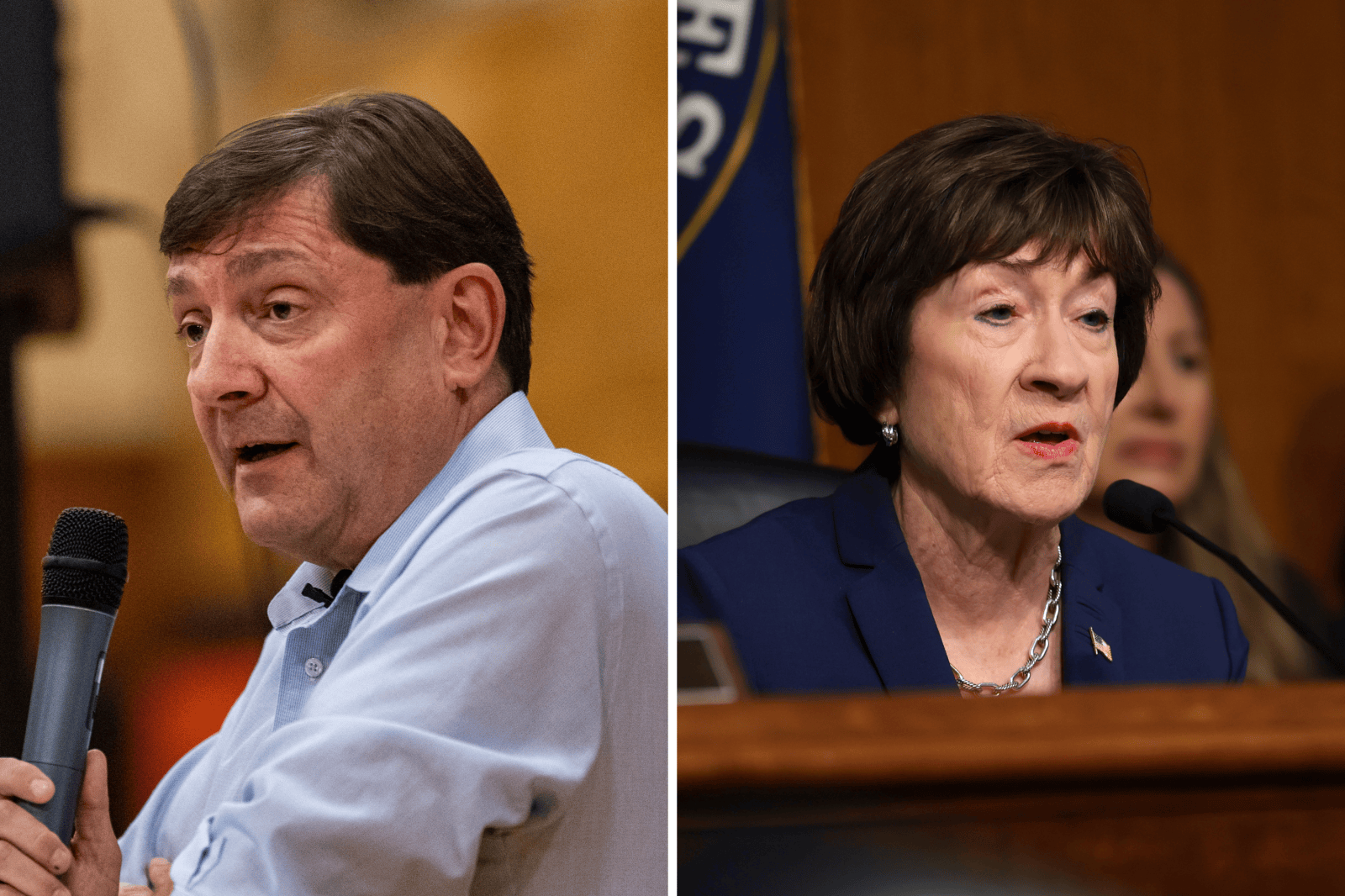
Republican Senator Susan Collins and her Democratic opponent Troy Jackson faced off in Portland in the initial debate of four scheduled for Maine’s pivotal Senate race. On this occasion, Collins defended her record and emphasized her bipartisan efforts, while Jackson attempted to associate Collins with former President Donald Trump, countering accusations about his inexperience. Post-debate reactions showed no clear winner. Each candidate had moments of strength, leaving much to be anticipated in the next debate slated for Thursday at 7 p.m.
The Importance of Maine’s Senate Race in the 2026 Midterms
Democrats currently have an edge in Senate polls, but this is much closer compared to the House. Maine’s Senate seat remains highly competitive, making it one of the key races to observe alongside those in Ohio and Texas.
Maine historically votes Democratic, having rejected Trump in the 2016, 2020, and 2024 elections. Collins has maintained her Senate seat since 1996 due to her reputation as a moderate Republican focused on delivering results for Maine. Despite this, the political environment in 2026 is more challenging for Republicans due to Trump’s low approval ratings. Collins has been attempting to distance herself from Trump, particularly on Canada tariffs.
Debate Highlights
The debate centered on whether Collins is genuinely a moderate Republican willing to advocate for Maine, or as Jackson implies, a staunch Trump supporter potentially compromising the interests of Maine residents.
Jackson tried to nationalize the race by connecting Collins’s 2018 vote for Supreme Court Justice Brett Kavanaugh to the overturning of Roe v. Wade and associating her with Trump’s tariffs on Canada, which are unpopular in Maine.
Collins countered by emphasizing her votes that assert Congress’s authority over war. She described herself as a strong opponent of Canadian tariffs and highlighted her efforts to safeguard Maine businesses from adverse effects.
A notable exchange occurred when Collins mentioned securing a tariff exemption for Canadian road salt. Jackson retorted, “We can’t eat road salt.”
Collins disputed a statistic used by Jackson’s campaign, claiming she votes with Trump 96% of the time. She argued the statistic from the Bangor Daily News was misleading, stating the true figure is 70%. VoteView categorizes Collins as one of the most centrist Republicans based on congressional votes.
When asked if Trump would support her campaign trail, Collins remarked on not being Trump’s favorite senator.
Assessing Debate Success
Post-debate reactions did not identify a clear winner, with opinions divided along party lines.
Democrats suggested Jackson had Collins defensively addressing her Kavanaugh vote and Trump support. Jackson used an analogy quoted extensively post-debate, likening Collins to an “arsonist” seeking recognition for minor remedies.
State Senate President Mattie Daughtry declared Jackson the debate victor, citing his ability to place Collins on the defensive.
Collins also had moments reflecting her experience and political distance from Trump. Republicans highlighted her congressional experience and bipartisan efficacy.
Democratic strategist Denny Salas commended Collins’s bipartisan approach and legislative accomplishments, stating she knows how to productively collaborate.
Following the debate, Jackson’s lead in prediction markets decreased slightly to 57% from 59%, while his chances improved marginally on Kalshi.
Political commentator Phil Harriman described the debate as evenly matched, recognizing Jackson’s effort to frame Collins as a Trump loyalist but acknowledging her voting record for representing diverse interests.
Impact of the Debates
Both candidates faced significant stakes in the first debate, amid an evenly divided poll and considerable undecided voters.
A CBS News survey revealed a tie between the candidates, with 10% of voters open to changing their choice before the election.
Jackson faces visibility challenges, having replaced Graham Platner, who withdrew after assault allegations he denies.
A co/efficient poll from late September showed 16% of likely voters had no opinion on Jackson compared to 9% for Collins.
A separate poll by the New York Times found 6% hadn’t heard of Jackson and 4% had no opinion.
Despite the competitive nature, Andrew E. Smith, a political science professor, believes debates won’t decide the race barring any major candidate missteps.
Harriman, on the other hand, suggested debates might significantly sway undecided voters searching for a credible representation for Maine.
Ultimately, undecided voters may use debates to discern which candidate exhibits the qualities needed to represent Maine effectively.