
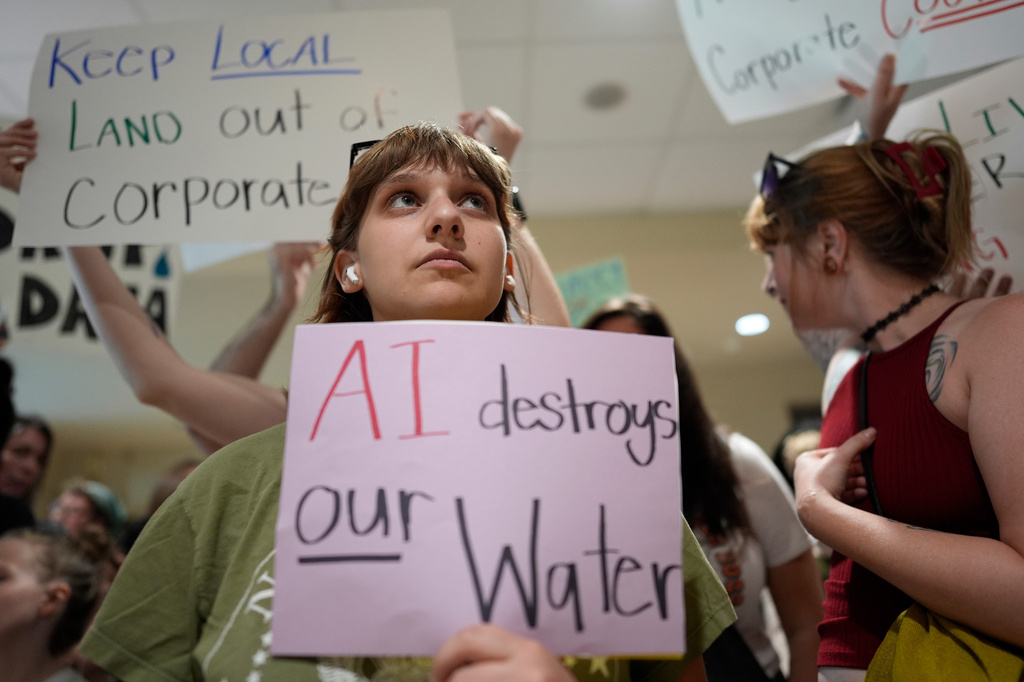
On June 11, 2026, Alexandra Crawford stood outside a planning commission meeting in Nashville, Tennessee, holding a sign. The meeting was set to consider a new ordinance to regulate data centers. These centers are becoming a focus in the race for artificial intelligence, competing not only in semiconductors, models, and talent, but also in electricity and infrastructure.
This focus on infrastructure is shifting the dynamics of Chinese influence in the U.S. Historically, U.S. policymakers aimed to counter Chinese cyber espionage and influence campaigns. As these targets became more secure, China’s strategies evolved. Instead of pushing pro-China messages, they now amplify existing domestic conflicts within important industries.
Earlier this year, OpenAI identified a Chinese influence campaign targeting U.S. data centers. The operation, called ‘Data Center Bandwagon,’ used ChatGPT to create fake social media posts. These posts falsely claimed data centers would raise electricity costs and harm communities. Though small in scope, the campaign highlighted an adaptation in China’s influence tactics by intervening in ongoing American policy debates.
Graphika’s investigations found that similar operations, termed ‘Spamouflage,’ create fake American personas to influence issues like the elections. Meanwhile, Microsoft’s reports note that Chinese influence methods have grown more sophisticated, exploiting critical political issues.
The rise of data centers represents a vital debate. These centers support AI breakthroughs, cloud computing, and military advancements. Both the U.S. and China see AI leadership as a crucial factor in their future economic and military strength. While Chinese media criticizes U.S. data centers for environmental and economic costs, China continues to bolster its own AI infrastructure, with data center demand projected to double by 2030.
It’s crucial to distinguish between authentic local concerns and foreign-influenced movements. Communities genuinely worry about energy use, water consumption, and land implications. Yet some reporting might misrepresent these situations, suggesting coordinated Chinese actions where there might be none.
Foreign influence does not create issues from nothing. It amplifies pre-existing social and political tensions, which supports strategic goals. This pattern appears across several campaigns, including one documented by Mandiant in 2022, known as Operation Dragonbridge. It falsely represented locals opposed to a rare earth facility in Texas. Google has since deleted thousands of related accounts on its platforms.
The focus of Chinese influence is evolving. Where once it targeted rare earth processing, it now seems to impact AI infrastructure. It might soon involve other critical areas like transmission lines or semiconductor factories. The strategy remains the same: promoting Beijing’s preferred results within seemingly authentic American debates.
The U.S. should maintain its democratic values, allowing open and robust debates that are vital for community development in industrial projects. Yet it is critical to prevent China’s misleading tactics from influencing these discussions, especially as it accelerates its own infrastructure development.
The challenge lies in identifying authentic debates versus organized foreign efforts that aim to divide discussions around essential technologies.
Nikolas Foster, a nonresident fellow with the Atlantic Council’s Global China Hub, previously served as deputy China advisor to the USAID administrator.
Copyright 2026 Nexstar Media Inc. All rights reserved. This material may not be published, broadcast, rewritten, or redistributed.