
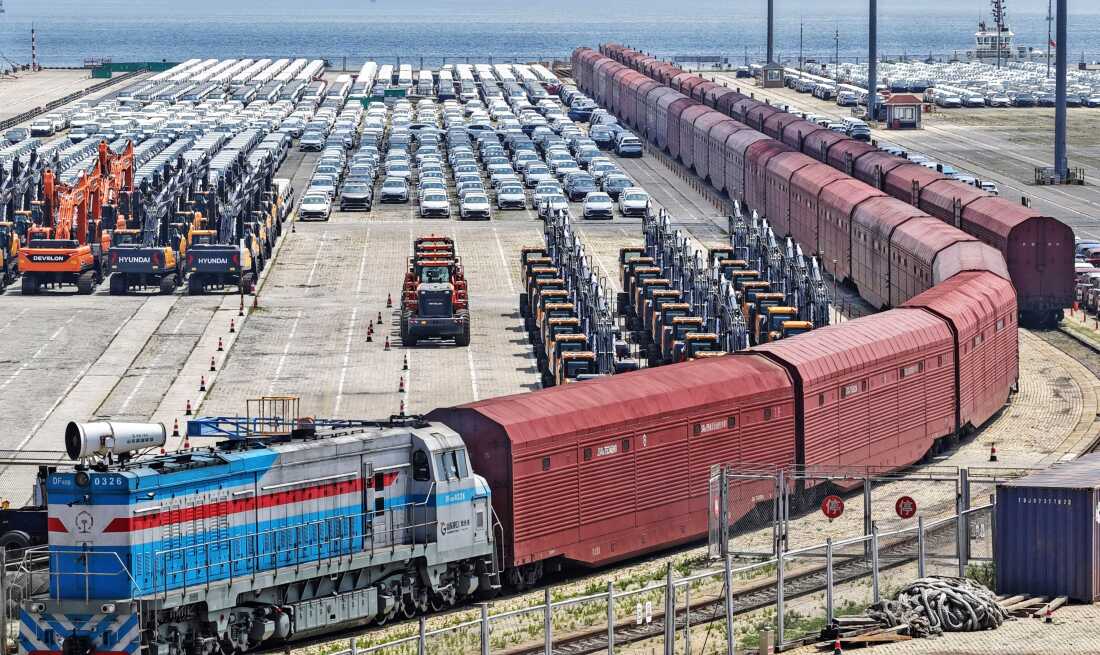
Heavy equipment and cars are being readied for transportation by rail in Yantai, in the Shandong province of eastern China, as of June 20, 2026. Recent official data revealed that China’s economic growth slowed markedly to a 4.3% annualized pace in the April-June quarter. This is the weakest rate in over three years and falls short of forecasts. It is a significant drop from the robust 5% growth recorded in January-March this year, despite a surge in exports driven by artificial intelligence and strong global demand for Chinese electric vehicles.
China has largely absorbed the economic effects of the Iran war, which has pushed global inflation higher due to rising energy prices. According to customs data, exports increased by 17.6% in the first six months of the year compared to the previous year and saw a 27% rise in June alone. Despite this growth, domestic spending and investment remain sluggish, limiting the positive impact of export manufacturing on the economy. The recovery has been slow since parts of China faced lockdowns during the COVID-19 pandemic.
“This was the slowest growth in any quarter since the lockdown-impacted fourth quarter of 2022,” noted Lynn Song, the chief economist for Greater China at ING Bank.
Some economists express concern over the imbalance in China’s economy. While substantial state support and private investments focus on advanced technologies like AI, computer chips, and robotics, other sectors such as lower-value manufacturing and service industries lag behind. High-tech product exports, including electric vehicles and electronic equipment, have risen with robust government backing, as China’s leadership prioritizes advanced technology development.
China’s trade surplus reached a record $1.2 trillion last year. This has ignited complaints from other countries’ policymakers about trade imbalances. The generous state subsidies are said to cause an oversupply of manufactured goods, which are then exported. Industrial output by value grew by 5.4% in the first half of the year from the previous year. The rise of AI and robotics also sparks concerns about future job creation to maintain long-term growth.
Chinese households have reduced significant purchases due to a prolonged property slump and uncertainty over jobs and wages. The economy remains heavily dependent on exports for growth. “China’s growth model has become increasingly imbalanced,” remarked Eswar Prasad, a professor of economics at Cornell University. Boosting domestic demand proves challenging as confidence is low.
Mao Shengyong, deputy head of China’s National Bureau of Statistics, highlighted the domestic challenges, citing an “acute” imbalance between strong supply and weak demand. He asserted that while aiming for “higher-quality economic growth,” China is working towards a stable domestic market and maintaining stable employment.
Some economic indicators show weaknesses. Investment in fixed assets, like factory equipment, declined 5.7% year-on-year in the first half, and retail sales of consumer goods saw a minimal 1.3% rise. Housing prices also continue to fall.
“China’s economy is going through a significant transition,” stated Wei Li, Head of Multi-Asset Investments at BNP Paribas Securities (China).
The target for economic growth set by Chinese leaders for 2026 ranges between 4.5% and 5%, slower than the previous year’s 5%. Recently released data shows the economy grew by 4.7% in the first half of the year. The International Monetary Fund adjusted its forecast for China’s annual growth, increasing it by 0.2 percentage points to 4.6%, and anticipates a 4.1% expansion in 2027.