
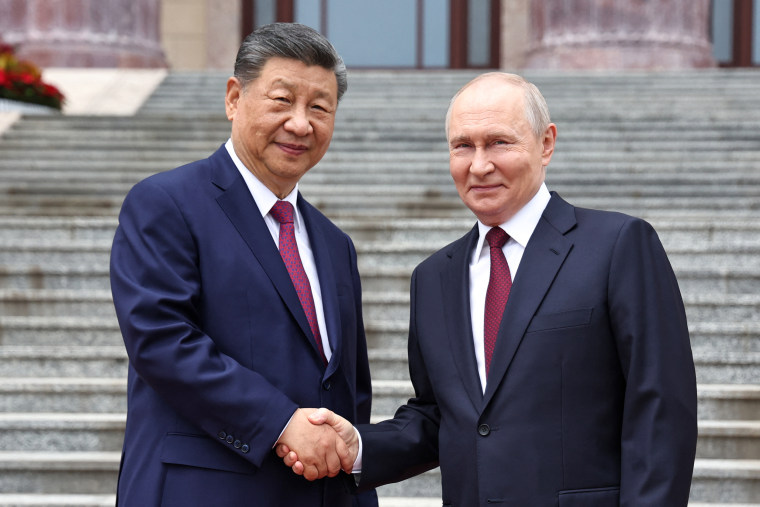
In Beijing, Chinese leader Xi Jinping declared that relations between China and Russia have reached a historic high. This statement came during a meeting with Russian President Vladimir Putin, following U.S. President Donald Trump’s visit to China. Xi emphasized that the shifting global landscape required a strong China-Russia partnership to stabilize international dynamics.
During a ceremonial welcome at the Great Hall of the People, a military band played the national anthems of both nations, accompanied by a 21-gun salute in Tiananmen Square. This ceremony mirrored the reception Trump received during his recent visit, highlighting China’s effort to reaffirm its alliance with Russia after engaging with the United States.
Although neither leader mentioned the United States directly, Xi’s comments on rising unilateral tendencies alluded to global tensions. Both Xi and Putin have criticized the U.S. stance on the conflict involving Israel and Iran, advocating for peace to maintain global energy stability. Putin highlighted that Russia serves as a dependable energy partner in these turbulent times.
Expressing camaraderie, Putin referred to Xi as his ‘dear friend’ and extended an invitation for Xi to visit Russia next year; he used a Chinese idiom to express closeness, indicating that time apart felt lengthy. The leaders signed numerous agreements in commerce, education, science, and technology, alongside committing to a second gas pipeline from Russia to China, termed the Power of Siberia 2, though without a set timeline.
A key component of the meeting was the signing of joint statements to enhance their ‘comprehensive strategic partnership’ and endorse a multipolar world order. The leaders also renewed the Sino-Russian Treaty of Friendship from 2001 and criticized the U.S. ‘Golden Dome’ missile defense project, citing it as a threat to global stability. They criticized the U.S. for allowing the 2010 New START nuclear arms treaty to expire.
Putin promoted the strengthened trade relations between Russia and China, noting that these have intensified following Russia’s actions in Ukraine. Despite China’s neutral public stance on the conflict, it has supported Russia diplomatically and economically. The Chinese Foreign Affairs Ministry denied claims reported by the Financial Times about Xi expressing doubt over Putin’s decisions regarding Ukraine. Russia welcomed China’s attempt to mediate a peaceful resolution in Ukraine.
In parallel developments, the Chinese Commerce Ministry confirmed details of recent agreements with the United States announced by the White House. Notable agreements include China’s purchase of 200 aircraft from Boeing and the resumption of U.S. beef and poultry imports. Additionally, tariff reductions on $30 billion in goods and the establishment of an investment board were announced, although unconfirmed reports of China committing to annual agricultural purchases remain.
U.N. Secretary-General António Guterres commented in Tokyo on the Trump-Xi summit, stating it reduced tensions without substantial breakthroughs, placing significant importance on Xi’s upcoming U.S. visit. Potential further meetings between Trump and Xi in coming months could shape future diplomatic engagements, alongside speculated interactions between Trump and Putin at the APEC summit in Shenzhen, as stated by Russian officials.