
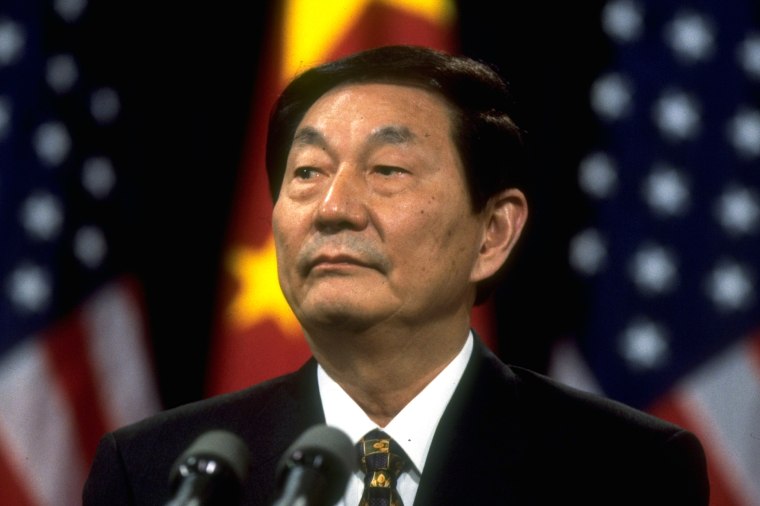
In Beijing, former Premier Zhu Rongji was cremated on Tuesday, and China lowered its national flag in mourning. Zhu, a revered reformer, passed away last week at the age of 97. As the nation remembered his era, people evaluated his complex legacy.
Security was notably heightened throughout Beijing, especially around Tiananmen Square and Zhongnanhai, the hub of political power. Zhu’s funeral procession passed these areas en route to Babaoshan crematorium. Xinhua, China’s state news agency, reported that President Xi Jinping and all seven members of the Politburo standing committee honored Zhu with three silent bows before the cremation.
Former President Hu Jintao, 83, who has been absent from multiple public events recently, sent a condolence wreath for Zhu, who was the second-most powerful official during Hu’s time. Zhu served as vice premier from 1991 to 1998 and then as premier until 2003, steering China through significant economic transformations during the 1990s.

He managed to control rampant inflation and reformed tax and banking sectors. His actions prompted restructuring of the state sector, causing job losses but also paving the way for China’s admission to the World Trade Organization in 2001. Zhu’s leadership was characterized by his independent thinking, as he once stated in 1988 while addressing officials in Shanghai.
In the late 1950s, Zhu’s Communist Party membership was revoked due to a brief candid speech; it was only reinstated after almost two decades. Following his death, Chinese social media saw a wave of mourning, though some reactions were mixed. Posts reflected both praise and criticism, with some pointing to the job losses caused by his reforms.
“I believe I should say what I truly think,”
Zhu emphasized during his tenure.
Deaths of admired leaders in China, like Zhu, often trigger an emotional response from the public. Authorities remain cautious, as they fear these events might incite instability. Popular sentiments sometimes shift from mourning to criticism of current leadership. When Zhou Enlai, the People’s Republic’s first premier, died in 1976, a public protest against Cultural Revolution excesses ensued. Similarly, Hu Yaobang’s death in 1989 led to pro-democracy protests followed by a severe crackdown.
Despite strict control over public expressions of grief, memories of Zhu continue to circulate. Many citizens still feel nostalgic about his leadership era, recalling the early days of China’s rapid economic growth.
A 39-year-old IT worker, Zhao, using only his surname, shared, “People are still quite nostalgic for him … and some seemed genuinely moved and almost tearful.” Zhu’s death reminds many of the significant changes China has undergone over the past 20 years.