
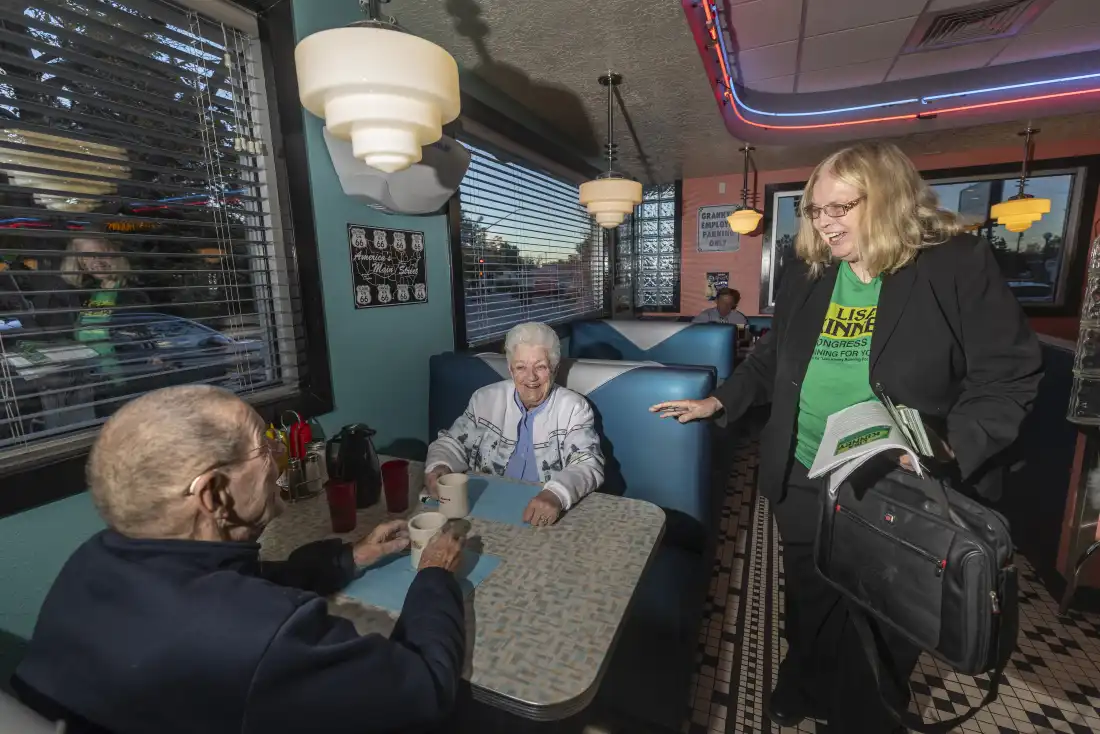
Democratic congressional candidate Lisa Kinney recently campaigned at Johnny J’s Diner in Casper, Wyoming on October 19, 2026. Her campaign highlights the significant challenges faced by candidates running outside the dominant political party in their states.
This election cycle has seen extensive coverage of competitive races that could influence congressional control. However, only a small portion of races are considered toss-ups. Approximately 80% are solidly Republican or Democrat. Candidates facing this political landscape often grapple with limited resources, fewer donors, and minimal staff support.
Running for office in these conditions poses a difficult question: what’s the experience like when prevailing opinion suggests a probable loss? This is a frequent question for Lisa Kinney, a Democrat contending for Wyoming’s sole House seat, a position held by Republicans since the late 1970s.
“I don’t think the people of Wyoming always hear both sides,” Kinney remarks during her campaign stop in Casper. “I’m glad to give another opinion. And I’m a Wyomingite, so I’m still moderate no matter what.”
An advertisement from her opponent places her alongside figures like Bernie Sanders and New York City Mayor Zohran Mamdani. Kinney finds humor in this portrayal, despite its puzzling nature. “What’s he thinking — that we all get together and do socialist stuff?” she jokes, engaging with early diners at Johnny J’s.
Kinney encounters mixed reactions, including straightforward refusals from some who prefer politics kept away from breakfast. Others cite a lack of support for figures like Immigration and Customs Enforcement or disapproval of Democratic stances on transgender issues.
She also meets Joe Beck, an unaffiliated voter skeptical of Kinney’s potential impact. “How are you going to turn things around?” he inquires. Kinney responds, “You need a person in there — that’s me — who’s a moderate who can talk to Republicans, who can talk to Democrats. I swear to you we’re going to make a difference.” Beck eventually reveals he has already voted for her but warns of the challenging political environment in Wyoming.
With minimal party infrastructure, Kinney, a former state senator, lacks a campaign office and has a few “helpers” across the state. Her focus is on public land preservation and reducing healthcare costs. “It’s really tiring — but we have to see as many people as we can,” she says. “If they can meet me, they feel more comfortable voting for me.”
Her husband, Rodney Lang, adds, “If we lose, the good news is the party’s stronger, and we think we’ve contributed to that.” Kinney remains optimistic. “But I always have it in my mind that I can win,” she shares.
Facing a Similar Struggle
George Austin, a home builder and former football coach, resonates with Kinney’s experience. Running as a Republican in Connecticut’s Democratic stronghold, he finds himself on a parallel path. Both candidates confront deeply entrenched partisan divides in their states.
Eric Ostermeier from Smart Politics notes that currently, 19 state delegations consist wholly of one political party, a peak not seen since 1953. Factors such as gerrymandering and geographic voter sorting contribute to these trends. Ostermeier also points out the challenges state candidates face in distinguishing themselves from national party identities.
Austin encounters voter disengagement when his Republican affiliation surfaces. He attempts to steer discussions to common ground, like congressional stasis and term limits. He desires to restore balance in Connecticut’s second congressional district, challenging the Democratic incumbent, Joe Courtney.
A substantial number of uncontested races in Connecticut motivate Austin. “I want to win, I’m competitive and I believe in the cause,” he says. But he also hopes to inspire others to view political participation as worthwhile.
Nationally, many legislative seats are predetermined due to lack of competition. In Connecticut, 46 of 187 legislative seats go uncontested. Austin, deeply invested in the cause, has contributed significantly to his campaign financially. “I’m successful, but I’m a far cry from wealthy — it’s just what the people deserved,” he explains.
Despite the difficulties, he recognizes the importance of running for office even when facing long odds. “Word of caution — you really have to decide if you’re in it for the right reasons,” he emphasizes. “It ain’t for everyone, I’ll tell you that right now.”
Both Kinney and Austin persevere in challenging environments. “Even if it was, you could argue that lost causes are the only ones worth fighting for,” Austin concludes.
Chris Polansky from Connecticut Public contributed reporting.