
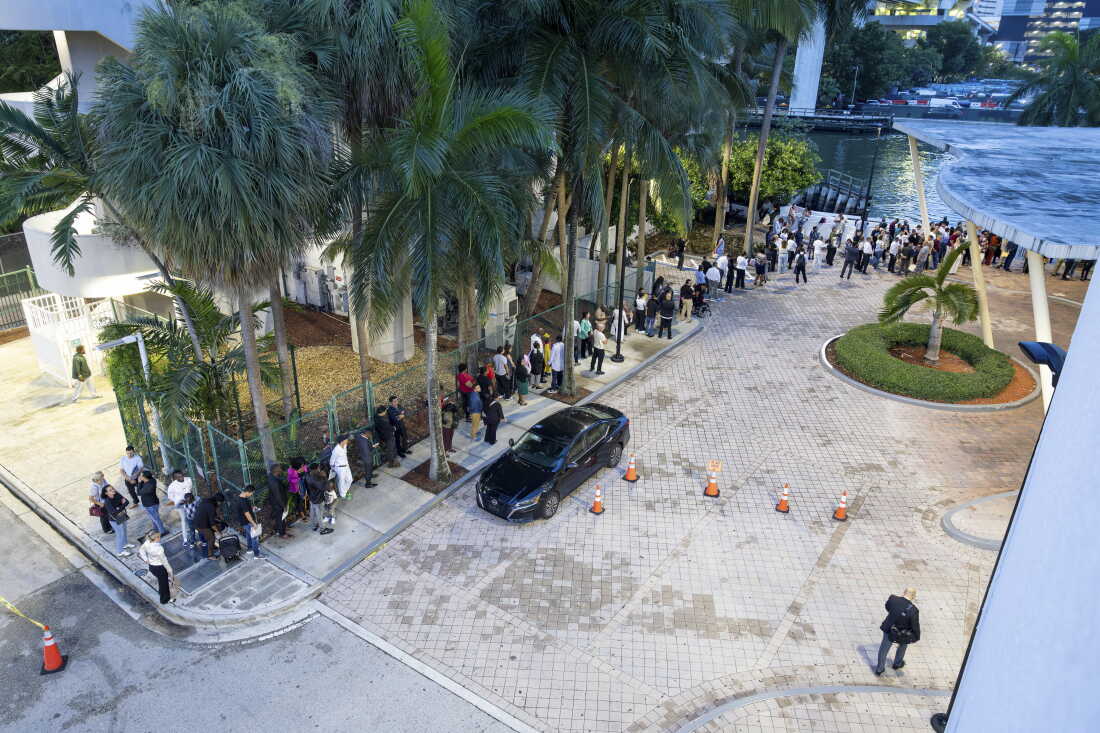
Long lines are now a regular sight outside the Miami Immigration Court as a new approach, known as “mega master” calendar hearings, unfolds. This tactic, introduced by the Trump administration, aims to expedite deportation procedures.
Yerandy Gonzalez, standing amidst the crowd, expresses disbelief: “This is crazy, man,” he states in Spanish, smoking a cigarette as he surveys the line.
The queue stretches across several blocks, filled with individuals awaiting their scheduled hearings, many attending court for the first time. Among them is Avene Jeanite, a 52-year-old Haitian man attending his appointment. Last month, he was present to support a friend facing deportation. Observing the changes, Jeanite remarked,
“It was not like this — you would go to the door and they’d let you in,” he noted. “Today is completely different.”
NPR reports chaos within the new system, highlighting how each judge’s capacity shifted from managing around three dozen cases daily to over a hundred. Critics argue this tactic aims to rapidly increase deportations, although officials claim it addresses a significant backlog.
David Wilson, vice chair of the American Immigration Lawyers Association’s committee asserts,
“It’s a very unfair, but a very effective tactic,”
given the ensuing chaos.
According to Wilson, the court struggles to distribute timely notices, complicating immigrants’ ability to secure legal representation. These changes reportedly led to a considerable uptick in missed court appearances. In Miami, in-absentia deportation orders grew considerably, with instances recorded rising from 1,383 in May to 2,886 by July.
Operational Strain and Increased Deportations
Details from courtroom 24 reveal packed conditions, as Judge Xavier Racine deals with 30 cases simultaneously, informing immigrants of their rights and assigning future hearings. Some hearings are rescheduled in as little as two weeks.
Various factors contribute to this overloaded docket: increasing arrests, rescheduling long-term court dates, and revisiting cases previously considered low priority. One Venezuelan mother, Yeriné, had her 2027 hearing revamped to occur immediately. She expresses concern over potential delays for individuals awaiting their hearings.
Billie Botch, an observer with the American Friends Service Committee, claims these rapid scheduling changes produced numerous operational issues. With many showing up late due to extensive waiting periods, Botch concludes,
“You put more people into proceedings on shorter notice with fewer resources… You’re going to end up with more removal orders.”