
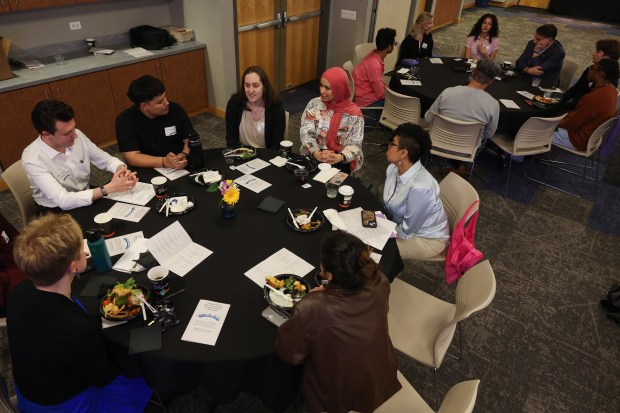
Isabela Torres Reyes often takes a moment to pause before speaking, a change she has welcomed in recent months. As a recent graduate of DePaul University, Torres Reyes noticed she initially rushed to share her views without fully considering others. After a 10-week course on dialogue, she has improved her listening skills and developed a deeper understanding of conversations.
Torres Reyes participated in DePaul’s Bridgebuilding Fellowship, which helps students enhance dialogue skills across various ideologies. The program highlights how personal backgrounds and experiences influence viewpoints. She now asks questions about others’ priorities instead of focusing solely on differing opinions. This approach has helped facilitate more meaningful conversations.
Torres Reyes noted the scarcity of opportunities for people to think and respond thoughtfully before speaking. She emphasized the importance of learning to open up and engage in discussions, particularly within the college environment.
Dialogue programs aimed at reducing division among college students are gaining traction on many campuses. These initiatives address the perceived lack of conversations around differing views. In a time when social media and politics can polarize, campuses once recognized for open exchanges of ideas are experiencing increased division. A 2025 Pew Research Center survey indicated that nearly half of colleges receive average or poor ratings for exposing students to diverse opinions.
“There’s a collective and cohesive approach to building this community,” recent University of Chicago graduate Tyler Shasteen noted about his experience with dialogue programs at the civic policy institute.
Programs at universities in Chicago, such as DePaul and U. of C., aim to bridge divides and foster connections. DePaul’s Bridgebuilding Fellowship, started in 2025, teaches students communication skills and understanding across ideologies. Participants host events designed to spark dialogue, learning how tone and personal history impact communication. Many have found themselves listening more actively and looking beyond surface-level opinions.
The University of Chicago’s Institute of Politics also offers nonpartisan, extracurricular programs where students engage in dialogue. Meeting people in person helps humanize them beyond digital interactions. Ava Partridge, a U. of C. graduate, shared that engaging with people of diverse political backgrounds helped her see the potential for relationships between differing ideologies. The goal isn’t always to change opinions but to learn from varying perspectives.
“You have to see the person beyond just their opinion,” said DePaul graduate Umar Ryan. He noted that sharing childhood experiences in class dialogues helped students understand the roots of differing views.
Other Chicago-area programs, like Loyola University’s Community Circles and Northwestern University’s Litowitz Center for Enlightened Disagreement, draw on similar objectives. Northwestern’s program helps students practice open-mindedness and address cognitive biases. Participants reported better listening skills and a broader understanding of viewpoints.
Both cultural and practical impacts of dialogue programs are evident. DePaul University President Robert Manuel highlighted the importance of fostering productive dialogue within higher education. Initiatives across Chicago, from Northwestern to Loyola, illustrate the idea that connection is central to community.
As society evaluates the value of higher education, fostering effective dialogue and connection stands out as a key component.