
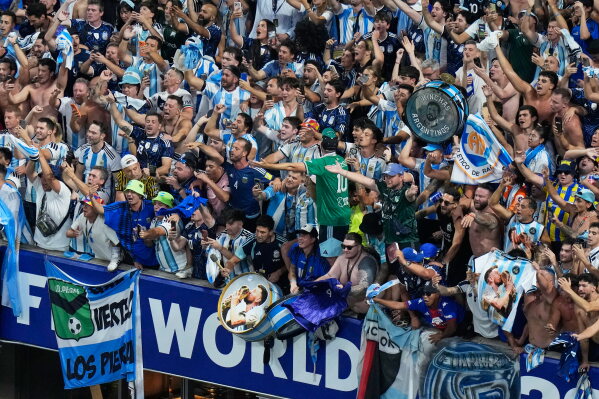
Tens of thousands of soccer fans overflowed into the streets of Buenos Aires on Wednesday night. They celebrated Argentina’s national team’s 2-1 triumph over England. This victory ensured their place in the World Cup final. The scene was a mix of emotions, with some shouting joyfully and others in tears. Many dashed through the streets in the rain, donning blue and white, the national colors.
Men and women climbed lamp posts and traffic lights, proudly waving Argentine flags. The euphoria seemed endless after Lautaro Martinez’s decisive goal in injury time. Argentina, the defending champions, will now face Spain in the final on Sunday.
“Look around at all these strangers, jumping and dancing together,” shared Rosana Beto Cruz, a 48-year-old nun, amidst the energetic crowd as they moved towards the Obelisk, a central monument in the city.
Fans emphasized that their joy was less about reaching the finals or defending their title won in Qatar four years prior, and more about overcoming a historical rival.
The match represented another chapter in the longstanding feud involving Argentina and Britain. This rivalry extends beyond sports, tracing back to British control over the disputed Falkland Islands, known as the Malvinas in Argentina.
For many, the victory had deeper significance. Maria Bertero, age 40, related the triumph to the painful past of the 1982 Falklands War. This conflict claimed the lives of 649 Argentines, many of whom were young conscripts.
“This is not just about football, it’s about beating the country that broke our hearts,” Bertero remarked.
While social media has seen allegations of favoritism towards Argentina by FIFA during the tournament, fans like Jorge Luis Lema dismiss such claims. Lema watched the match in a bar where tension turned to celebration after Enzo Fernandez’s goal at the 85th minute.
“It’s a lie. Football is football,” Lema declared. “Whoever wins, wins. And Argentina won once again.”
The Falklands War still looms over Argentinian soccer culture. It has significantly influenced the dynamics between the two nations since Diego Maradona’s legendary performance in the 1986 World Cup. However, the Argentine veterans urged that Maradona’s iconic goals have settled scores with England in sports.
On a personal note, Lionel Messi, considered one of the greatest players, left a memorable mark against England, potentially for the last time in his career. After the semi-final, the Argentine players raised a banner proclaiming the Falkland Islands as Argentine territory.
Young fans like Matías Adorno, wearing a Messi jersey, expressed admiration for Messi’s continued excellence at his age.
“Seeing Messi playing like this leaves me speechless,” Adorno said. “He’s given us absolutely everything.”
Throughout Buenos Aires, chants and cries celebrated Messi, Maradona, and the islands. Joy resonated, with many seeing the match as a source of much-needed unity amid political and economic challenges.
As Yanina Quinteros, 40, celebrated with her young daughter, she reflected on the night’s joy.
“All of us, grandparents, children, mothers, fathers, we’re all just here to celebrate tonight.”
President Javier Milei, known for his radical libertarian stance, also echoed the national sentiment, calling the victory an emotional triumph.