
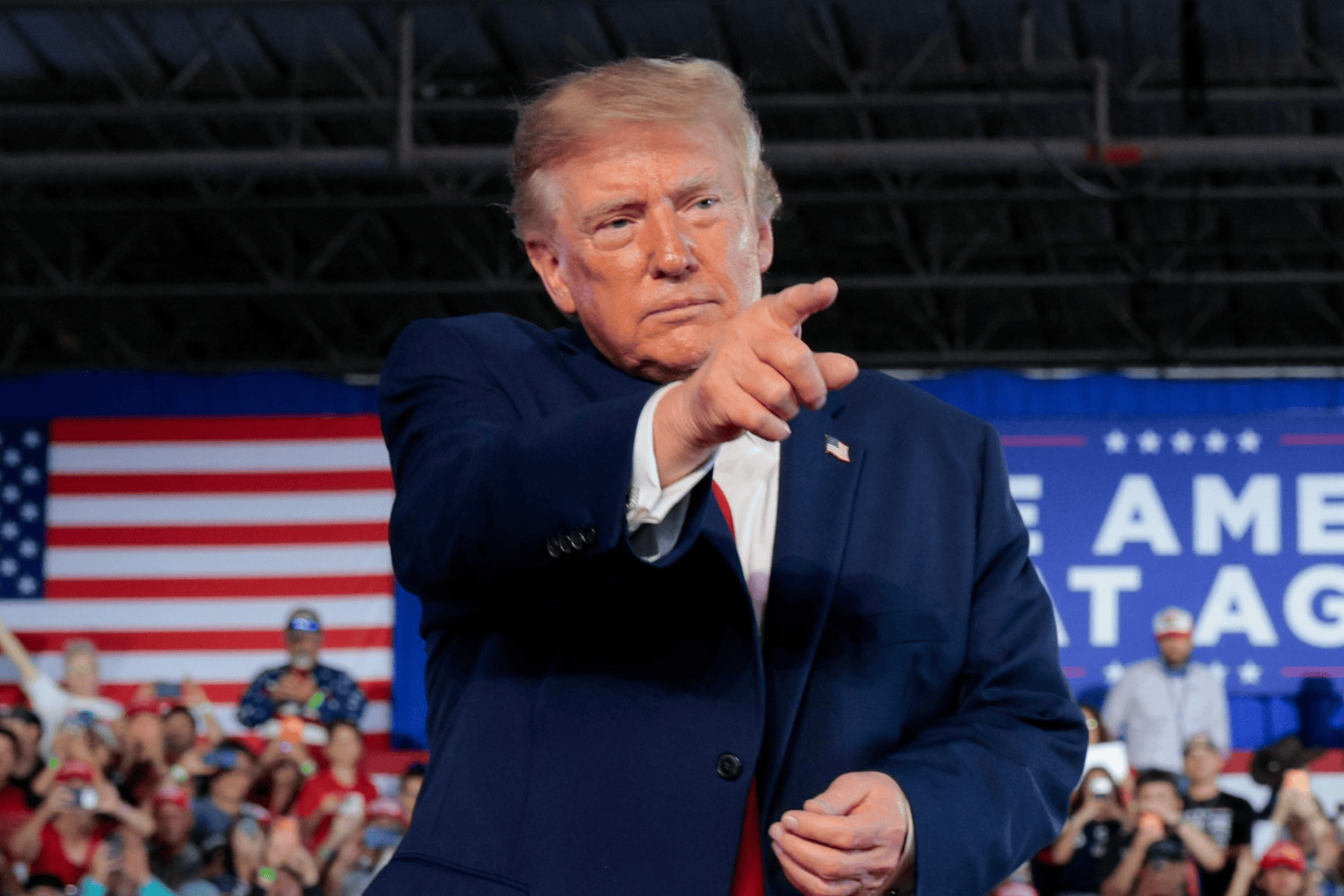
President Donald Trump’s approval rating has shown little change in the final month before the midterm elections, yet it’s noticeably weaker compared to the start of the year. This information stems from a Newsweek analysis of four national polling trackers. According to data from Civiqs, Silver Bulletin, The New York Times, and RealClearPolling, Trump’s net approval was over 20 percentage points underwater as of October 1. This scenario presents a challenging national environment for Republicans aiming to maintain control of Congress.
By October 29, Trump’s approval rating ranged from 33% to 38.4%, while approximately 60% disapproved across all measures. Compared to the beginning of 2026, Trump’s net approval rating worsened by 11 to 11.8 points. Historically, midterm elections have been challenging for the party in the White House, putting pressure on Republican congressional candidates as voters evaluate the first two years of Trump’s second term.
“In many ways, midterms are referenda on incumbent party performance,” said Costas Panagopoulos, a distinguished professor of political science at Northeastern University, to Newsweek.
During October, Civiqs recorded a slight decline in approval ratings. In contrast, averages from Silver Bulletin, The New York Times, and RealClearPolling showed modest improvements, though none signaled a significant late recovery. These polling averages use different surveys and methodologies, suggesting they should be compared for direction only.
White House spokesperson Davis Ingle claimed that Trump remains the Republican Party’s “unequivocal leader” and “unmatched motivator.” Ingle argued that Trump’s connection with the MAGA movement and his record in office would help the party protect its congressional majorities.
Civiqs Records Further Decline
On January 1, Civiqs placed Trump’s approval at 40% with a disapproval rating of 56%, resulting in a net rating of -16. By October 1, approval had decreased to 34% with disapproval at 60%, increasing the deficit to 26 points. The October 29 tracker showed a one-point drop to 33% approval, with disapproval remaining steady at 60%, resulting in a -27 net rating. This indicated a further one-point deterioration that month and an 11-point decline since January. The Civiqs tracker relies on 139,382 responses from registered voters collected from January 20, 2025, to October 29, 2026.
Silver Bulletin Shows Modest Rebound
Silver Bulletin began the year with Trump at 42.2% approval and 53.7% disapproval, resulting in a net rating of -11.5. By October 1, the figures shifted to 37.2% approval and 60.5% disapproval, widening the deficit to 23.3 points. The October 29 update placed approval at 37.3% and disapproval at 60.1%, yielding a net rating of -22.8. This showed a half-point improvement in October but was 11.3 points worse than at the start of 2026. The tracker noted that approval dipped to a record low of 36.3% before recovering by about one point.
The Times Moves One Point in October
The New York Times recorded Trump at 42% approval and 54% disapproval on January 1, leaving a net rating of -12. By October 1, approval was at 37% and disapproval at 61%, doubling the deficit to 24 points. On October 29, approval remained steady at 37% while disapproval dropped to 60%, improving the net rating by one point to -23. Despite this, it was still 11 points below the January level. The Times tracker uses a daily average of multiple surveys, with polls having higher weight represented more prominently.
RealClearPolling Shows Minimal Movement
At the year’s start, RealClearPolling showed approval at 43.4% and disapproval at 53.3%, with a net figure of -9.9. On October 1, approval decreased to 38.3% while disapproval increased to 60.2%, lowering net approval to -21.9. The latest data for October 9 to 28 reported 38.4% approval and 60.1% disapproval, producing a net rating of -21.7. This reflected a slight improvement of two-tenths of a point for October but an 11.8-point deterioration over the year.
Why the Estimates Vary
Costas Panagopoulos explained that pollsters aim to understand the preferences of potential voters, yet they use various methods to identify these participants. This approach creates differences in survey estimates, even with overlapping fieldwork. The RealClearPolling table ranges from 34% approval in a CNN survey of registered voters to 42% in an RMG Research poll of the same population.
Implications for Republicans
Presidential approval shapes the national context for Republican candidates but does not directly indicate how many congressional seats might change. Panagopoulos noted that congressional and other elections focusing on national issues mean that Republican control of Washington gives discontented voters a clear party to blame.
“If voters are unhappy, they know where to lay the blame,” Panagopoulos said.
He pointed out that independent voters could be particularly decisive in the current election cycle, as many who supported Trump in 2024 have shifted away from Republican support. However, local factors might lead to different outcomes, where Republican candidates with strong local appeal might outperform Trump in their areas.
The results of the midterms will reveal how closely the congressional map aligns with the national sentiment.