
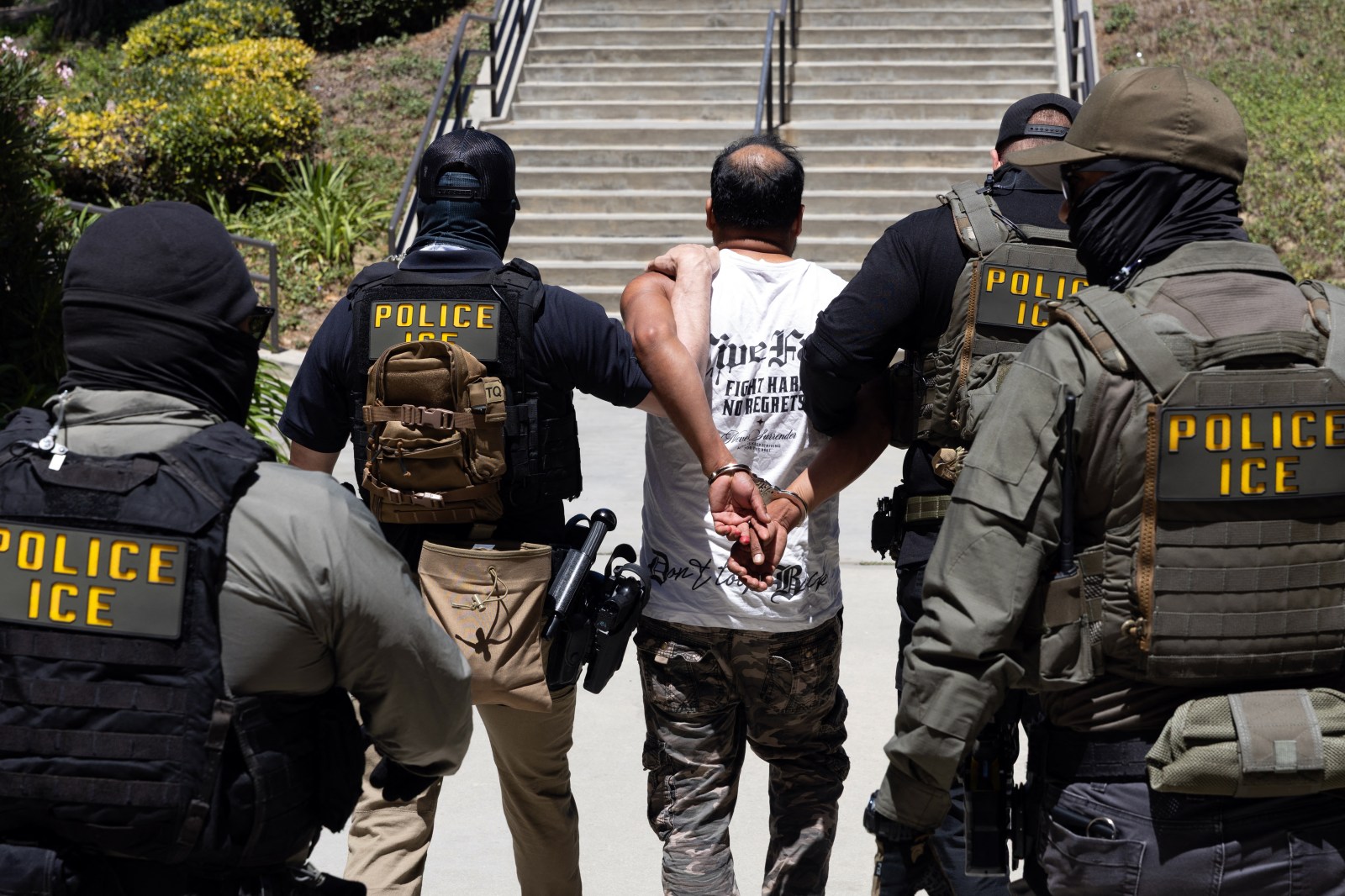
During President Donald Trump’s second term, only one in three people arrested by U.S. Immigration and Customs Enforcement (ICE) had a prior criminal conviction. This finding is based on a study published in the Proceedings of the National Academy of Sciences, which analyzed over a decade of ICE arrest data.
The research highlights a significant increase in arrests under both of Trump’s terms, yet a decline in the percentage of those arrested who had criminal convictions. This contrasts with the Department of Homeland Security’s (DHS) portrayal of targeting serious criminals.
The DHS spokesperson mentioned that many labeled as noncriminals could include individuals involved in activities such as terrorism or gang affiliation, who do not have U.S. criminal records.
The study analyzed about 1.6 million ICE arrests from October 2015 to March 2026, spanning the Obama, Biden, and Trump administrations. Researchers found that during Trump’s second term, 34% of arrestees had criminal convictions, a decline from 52% in Biden’s last year, 70% in Trump’s first year, and 79% in Obama’s final year.
The data suggests that the nature of immigration enforcement diverges from public narratives emphasizing public safety and criminal removal. Lead author Chloe East emphasized this contrast in a press release.
Substantial increases in arrests marked the start of both Trump presidencies, with 436 daily arrests in his first term’s early months. This was a 43% rise from the Obama era. By Trump’s second term’s early months, daily arrests grew to 952, a 214% increase from Biden’s last year.
The decline in the proportion of arrestees with criminal convictions partially relates to ICE changing its operational methods. Previously, many arrests occurred in law enforcement settings.
In January 2025, the Trump administration removed Biden’s restrictions on enforcement actions in sensitive areas, leading to a rise in community arrests, which account for locations outside jails or prisons.
Community arrests accounted for 44% of arrests after Trump’s return, up from 19% during Biden’s final year. Simultaneously, arrests through local law enforcement cooperation decreased from three-quarters to just over half.
The percentage of arrestees with criminal convictions declined in both community and local law enforcement-assisted arrests. Co-author Caitlin Patler noted that this trend was noticeable nationally, though tactics varied by region. Cities like Boston, Chicago, and New York saw increases in community arrests.
The study suggests that changes in enforcement tactics alone do not explain the declining share of criminal convictions among those arrested. Even with consistent arrest methods, the proportion of individuals with convictions fell as arrest numbers rose.
The Trump administration continues its hard-line enforcement and deportation policies. The study does not explore civil immigration violations or pending charges, focusing solely on prior convictions.
In July, during Trump’s second term, ICE set a monthly arrest record, detaining over 46,000 people for immigration violations.